Published February 26, 2026 01:45PM
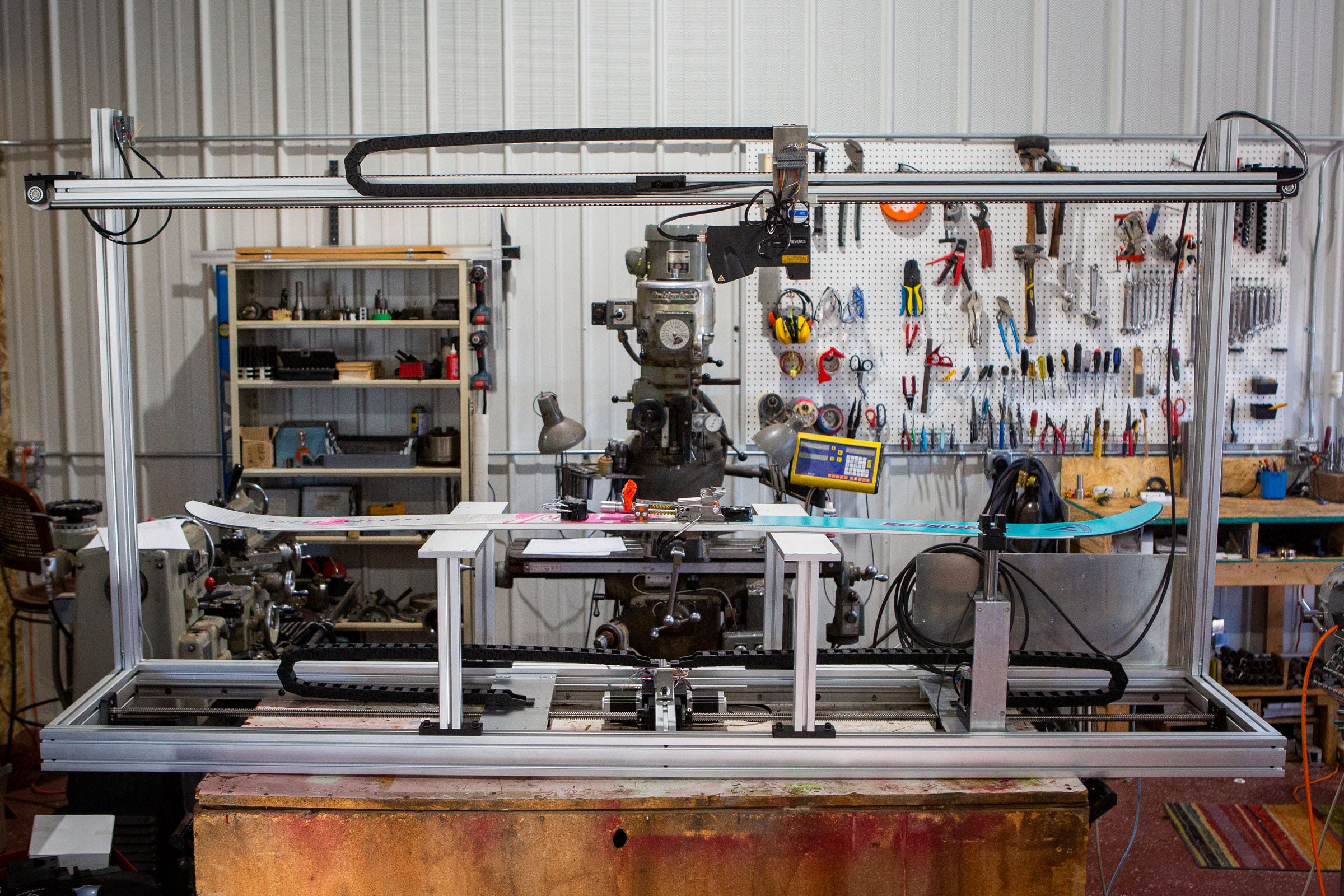
After 18 months of development and countless hours in the Outside Lab at CU Denver, we’re finally revealing the Outside Lab Ski and Snowboard Test Machine—and, in the process, creating a new standard for measuring and reporting flex profiles on our field-tested snow sports gear.
Backing up for a second, testing gear in the Outside Lab at CU Denver comes with challenges. Some products have standard tests to evaluate performance or safety, but these tests don’t always provide the information we really want to know. Other products have no standards or industry-accepted methods to accurately measure performance; instead, development often relies on experience and field feedback.
This second scenario is where our work at the Outside Lab really shines. Early on in the lab, we realized there were no industry standards for measuring and reporting flex profiles (including torsional, or edge engagement) for skis and snowboards. Having one method to measure the flex profile through the length, edge engagement, and complete geometry profile across brands will allow skiers and boarders to better compare products when deciding which tool is right for them. TL;DR: We’re removing the shop “hand” bend test and adding real values.
With the talented engineers at the Outside Lab, we researched current industry practices, identified the gaps and areas for improvement, and started designing. The result? The Outside Ski Test Machine.
In this video, I talk with Trevor Young (Research Services Program Manager, Ph.D. in Mechanical Engineering), my CU Denver counterpart in the Outside Lab, about how the machine was designed, what information it will allow us to add to our reviews, and how it’ll give you the information you need when choosing your next pair of skis.
Introducing the Ski and Snowboard Test Machine
Adam Trenkamp: Hey everybody. I’m Adam Trenkamp, Lab Test Editor here at the Outside Lab at CU Denver. Today I’m joined by Trevor Young, my counterpart in the lab; he works for CU Denver. I’m an engineer, but he’s a better one. So I enlisted his help for the Outside Lab to design a new machine. Trevor, what is this we’re looking at here today?
Trevor Young: Yeah, so this is our latest and greatest in the lab. This is our ski tester here at the Outside Lab.
AT: Why did we design this ski tester?
TY: Yeah, so as a lab team, we got together with the folks at SKI over at Outside and asked what kind of holes as far as information regarding ski or snowboard performance they had observed. What we found was that in general, bending stiffness [flex], or edge engagement stiffness to start your turns, was relatively minimally understood within the industry. We designed this machine to go ahead and capture objective lab-based data points around [flex and edge engagement] that we could then supply to manufacturers or our consumers of these products. One of the ways that we want to use it is to really help manufacturers dial in performance and various characteristics of a board—both the bending, stiffness and edge engagement stiffness—that have a big influence on how the board feels when you ride. And we also want to capture geometry like side cut radius, or the multiple side cut radii, again, which have a big influence on the way your ride feels and really help manufacturers start to dial in performance of their products.
AT: You mean, instead of doing this [as his hand flexes a ski], we’re now going to have a machine that actually provides a number to that so we can compare all of the skis or all of the boards and really put ’em on a stiffness scale?
TY: Yeah, exactly. Really comparing apples to apples with the use of this machine.
How We Designed the Ski and Snowboard Test Machine
AT: Awesome. So with that, seems like this is 100% new, original. How did you design this machine?
TY: Correct. So, we sat down internally as a lab team, and also had some meetings with manufacturers in the industry to really get a sense of what were the key performance points of interest to them. Then we went through three or four different iterations until we got to the final product that you see here today, which we believe offers us a lot of flexibility in terms of testing capability.
AT: Did we build this in-house, or did we outsource the build itself?
TY: We did outsource it. So we came up with an initial design and all of the components and then we outsourced it to Dave [Cleveland] over at Custom Engineering Solutions out in the Granby [Colorado] area to do the final assembly of the mechanical components.
AT: Upside to that, Colorado-designed and built in ski country. So it’s going to work well.
The Data Points: Bending Stiffness (Flex) and Edge Engagement
AT: What is this ski test machine actually capable of doing when we’re running tests?
TY: Sure. There’s a variety of different ways that we can test. Just about every component on the machine is adjustable based on how we want to define a particular test. We can do bending tests, either of tip and tail; we can do edge engagement tests, again for the tip and tail. We can do combinations of those, where we bend or twist each side of the ski or snowboard independently, or in conjunction with each other. And we can also measure the geometric profile of various skis and snowboards to start to really get a sense of how they’re shaped, and how they might perform or feel when you’re using them on the mountain.
AT: Cool. So we’re looking at stiffness along the length in our tail and our tip, which is going to give us a stiffness across the ski as a whole. We’re also looking at pushing just on one edge, getting that idea of edge engagement force. And then, when we do our scan for the profile, how exactly are we measuring the profile of the ski so that we can get the width and the radius of the side cut?
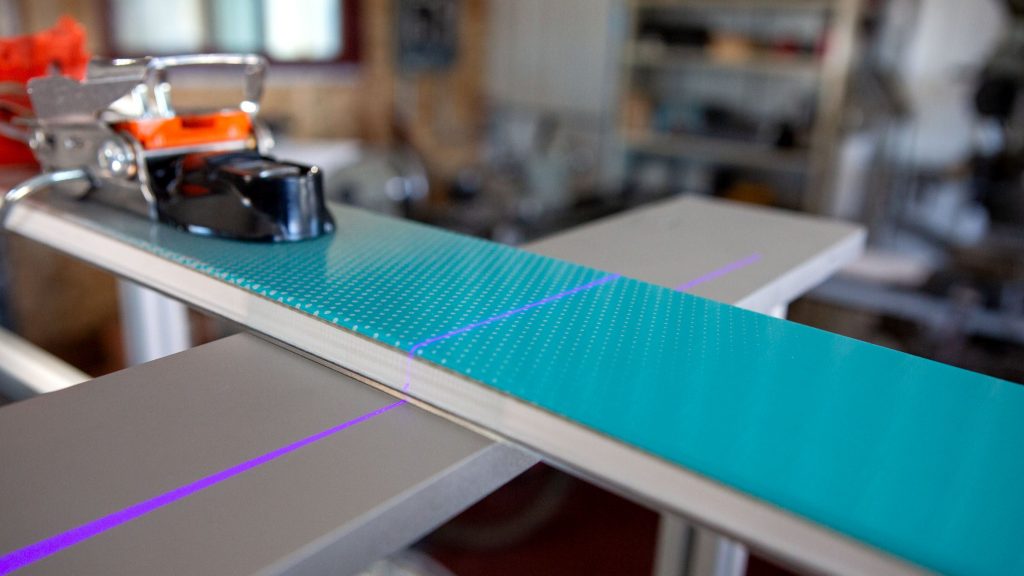
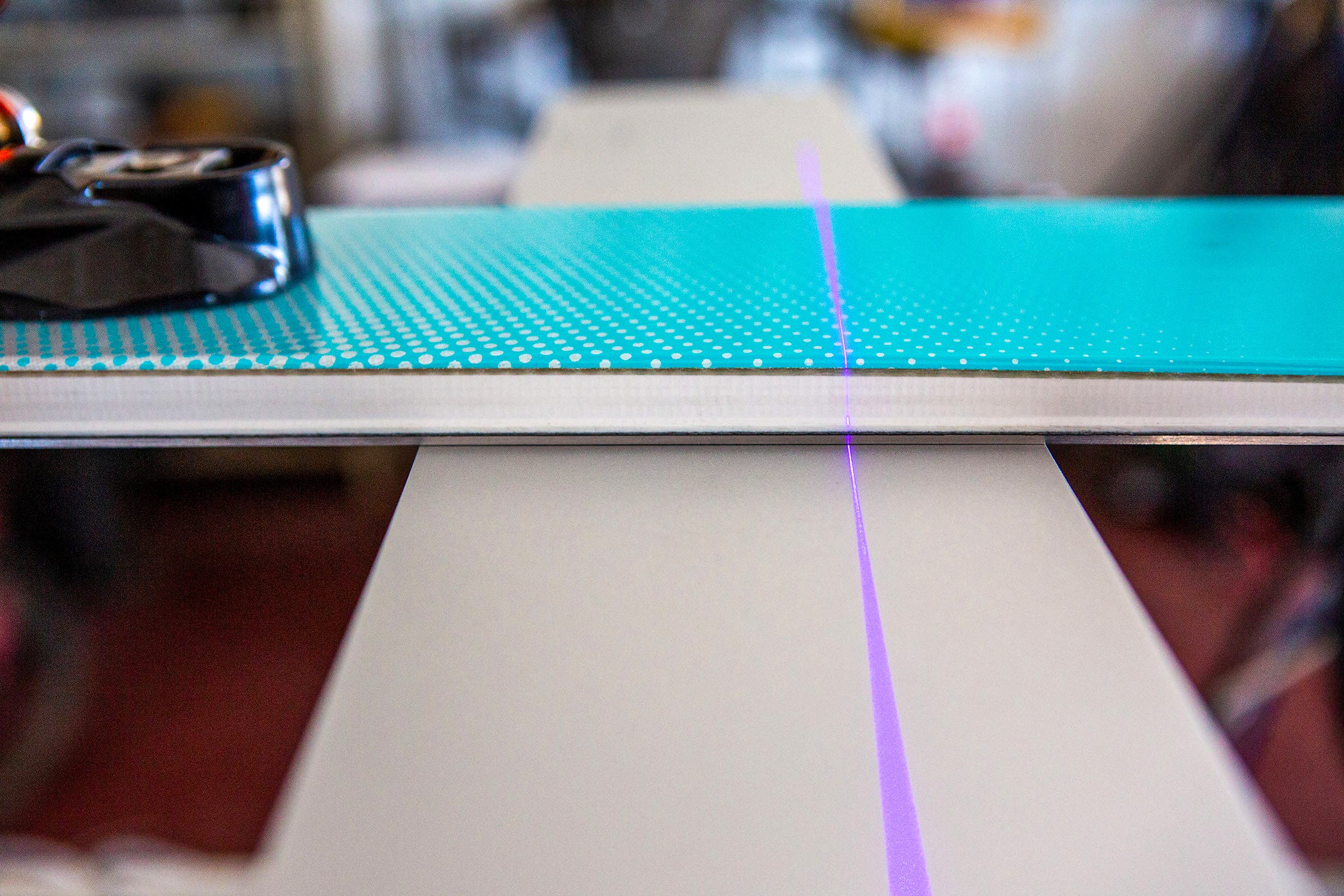
TY: Yeah, absolutely. We use a laser measurement system on our machine that has precision down to less than one-tenth of a millimeter. What that’s going to do is take geometric measurements of the ski at predefined points, that we decide as the experimenters, and then using that data we can do some post-processing and then back-calculate the stiffness from that information.
AT: Cool. So our laser scanner is actually right up here. It runs along the length and we’ll actually take measurements across the width. And then with that we’re able to measure [sidecut radius]. When we do that scan, since it’s above, are we still able to actually see what the thickness of the ski is, and measure the camber profile as well?
TY: Yes, absolutely. We can measure more or less all of the geometric properties of interest to us, with respect to a given ski or snowboard, across the entire length from its contact point to contact point.
What This Machine Means for Your Next Pair of Skis
AT: Is there anything else out there like this, or do you think this is going to be something new for the industry?
TY: I think what we’ve done here offers us a greater capacity to test in different load cases, different sizes, and in some cases machines that are currently available for this type of thing are exclusive to skis and exclude snowboards. So with our design, we wanted to make sure that we could handle both skis and snowboards
AT: And let’s be real, I snowboard, you snowboard. So, you know, this is a really skinny board, and we’d prefer if we got a real snowboard on here, not these skinny little two planks. But I think it’s important to learn for both. How’s this going to help our audience?
TY: We can compare across all of the products in a given brand’s line, or we can compare across brands how each of these skis or snowboards is performing. So when you’re going to buy your new ski or board, and you have an idea of how you would like your ride to feel, we can kind of help guide you to a place where you can choose a product, or a few products, that you’d like to demo with that specific performance in mind.
AT: Look for all of this data in upcoming ski and snowboard reviews. We’re excited to get this machine going. Trevor, thanks for designing an awesome piece of equipment that we are super pumped to have.