Updated March 17, 2026 04:33PM
It’s 6 p.m., and spring sun drenches the granite peaks, stacked as far north as the eye can see. The light is different in the Sierra–clearer, brighter, more distilled. Jenna Kane and Greg Cunningham move steadily forward, alternating between rock hopping and post-holing, packs and skis heavy on their backs. The summit of Mt. Whitney, inspiration for Jenna’s middle name, lies before them. The relief they feel in finally making it to the day’s high point is tempered by the disquiet thrumming just beneath it. Will it go?
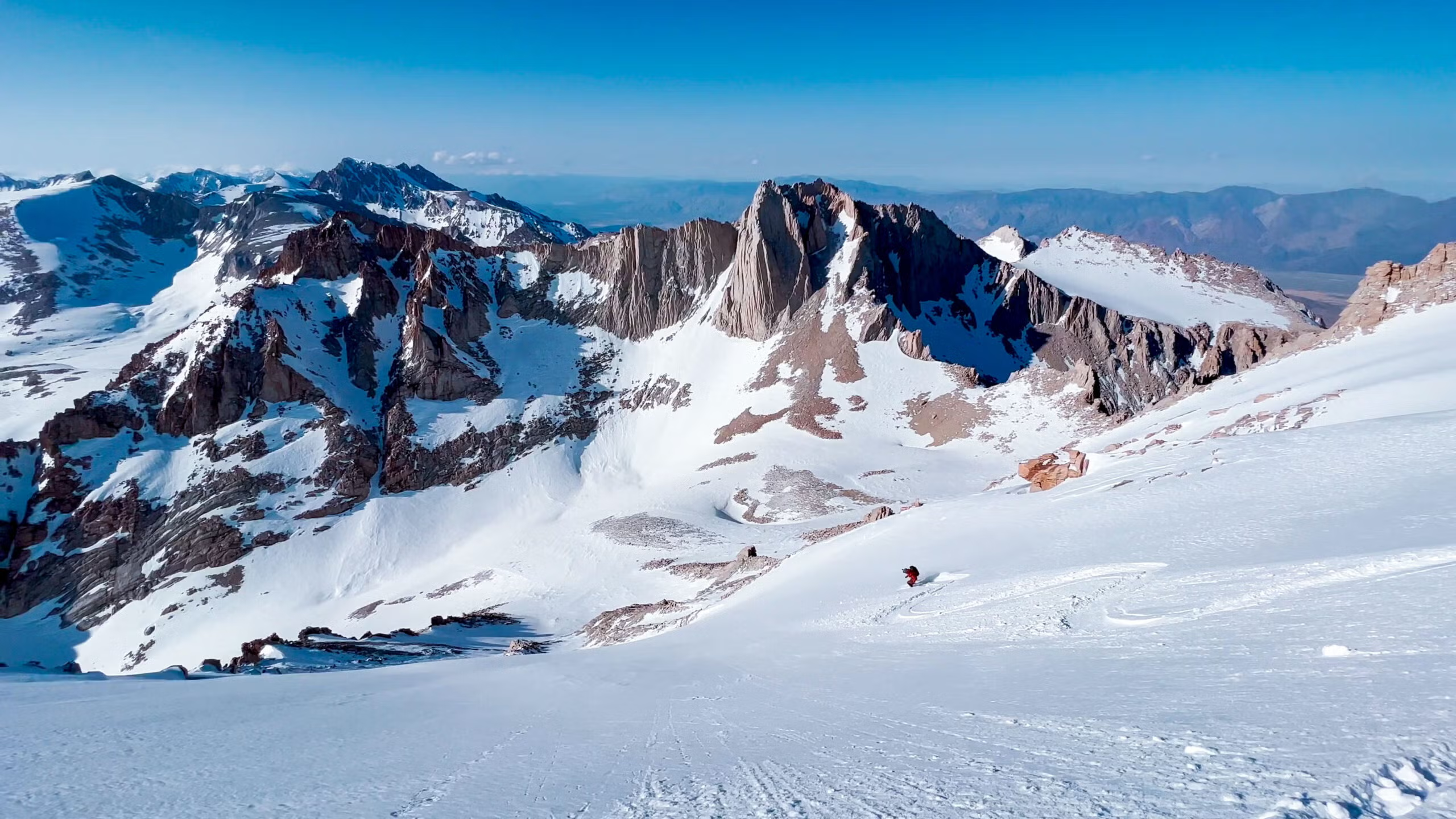
When they get to the wide, sloping summit, Cunningham dumps his pack, jogging to the edge to scope Whitney’s north face. It is a scarcely skied line, and one that will take them toward Mt. Russell, their next objective. Most people approach Whitney from the east, making a long day of it. Kane and Cunningham, though, are two days into their journey from the south—and this is only the beginning.
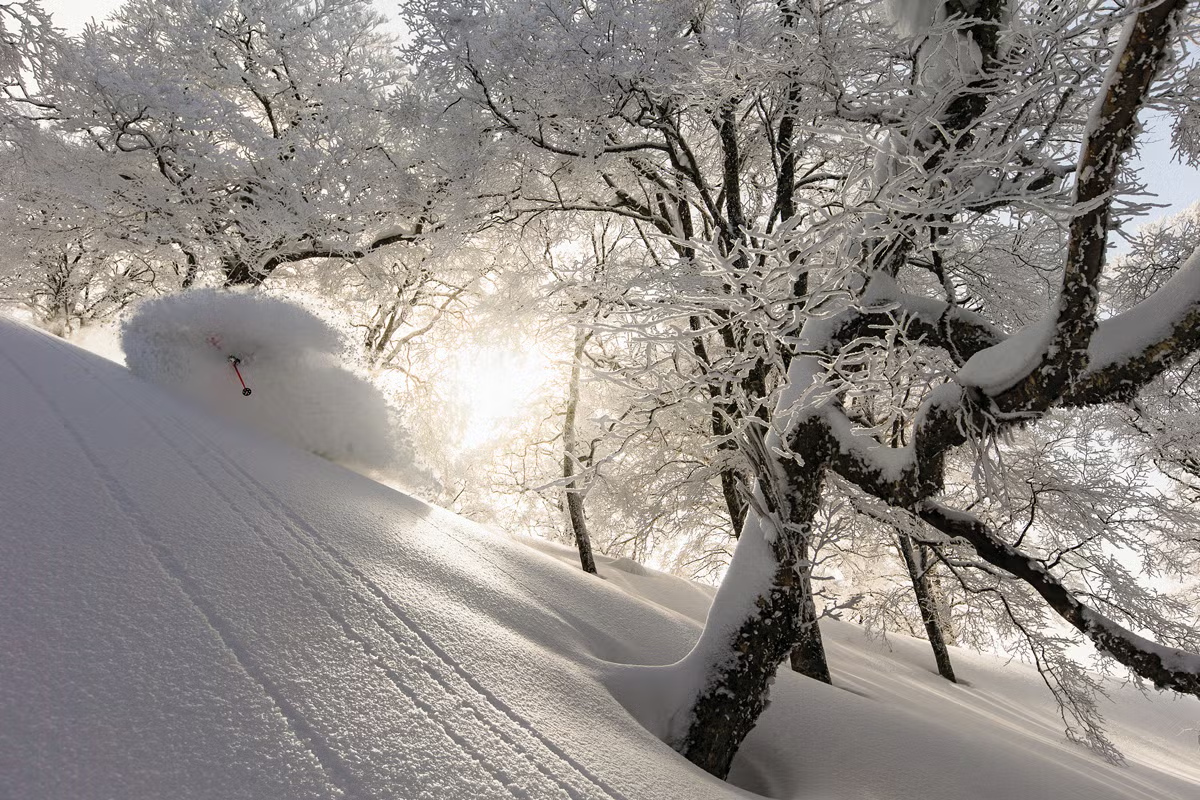
Cunningham returns looking confident—it’s in. Initial relief gives way to more uncertainty: What will conditions be like? This question will stay with them as they ski each line top-down, approaching from one side and skiing down the other. Cunningham drops in first, daring to hope, and is rewarded with a rare line in rare powder. Kane follows, arcing confident turns down the steep slope, releasing joyful whoops that echo out into the heart of the range they will have largely to themselves for the next 17 days.
These kinds of adventures now unfold in a very different landscape than the one the Redline’s founders moved through 40 years ago. Nowadays, routes are mapped in advance, tracks are saved, and so much less of the backcountry is unknown. At the same time, long, high-alpine ski traverses have become increasingly contingent on narrow windows of snow, stability, and timing that don’t come around every year. The Redline sits at the intersection of those shifts. It is an idea with history but no fixed route, a traverse that invites interpretation. And in following it, each skier is left to reckon with the same quiet question: how much of an adventure lies in fidelity to what came before, and how much in the line you choose to draw for yourself.
The Birth of the Redline
In the 1980s, California skiers Allan Bard, Chris Cox, and Tom Carter dreamed up a backcountry ski traverse across the Sierra Nevada. Their vision was a route that followed the geopolitical “red line” on maps along the Sierra Crest, separating the eastern and western watersheds, from Mt. Langley to Mammoth. The trio completed “The Redline Traverse” in sections during historic winters between 1981 and 1983—on randonee Nordic skis with three-pin bindings, leather boots, and heavy packs.
They left intentionally vague instructions for skiers looking to imitate their journey in a 1983 article in Powder Magazine—“we [strung] together dozens of exciting ski descents like so many pearls … crossed nearly fifty passes and climbed more than twenty peaks, rarely dropping below 11,000 feet.” The founders focused on the experience as much as the route—the use of the name “Redline” also referred to the idea of “redlining the fun meter.”
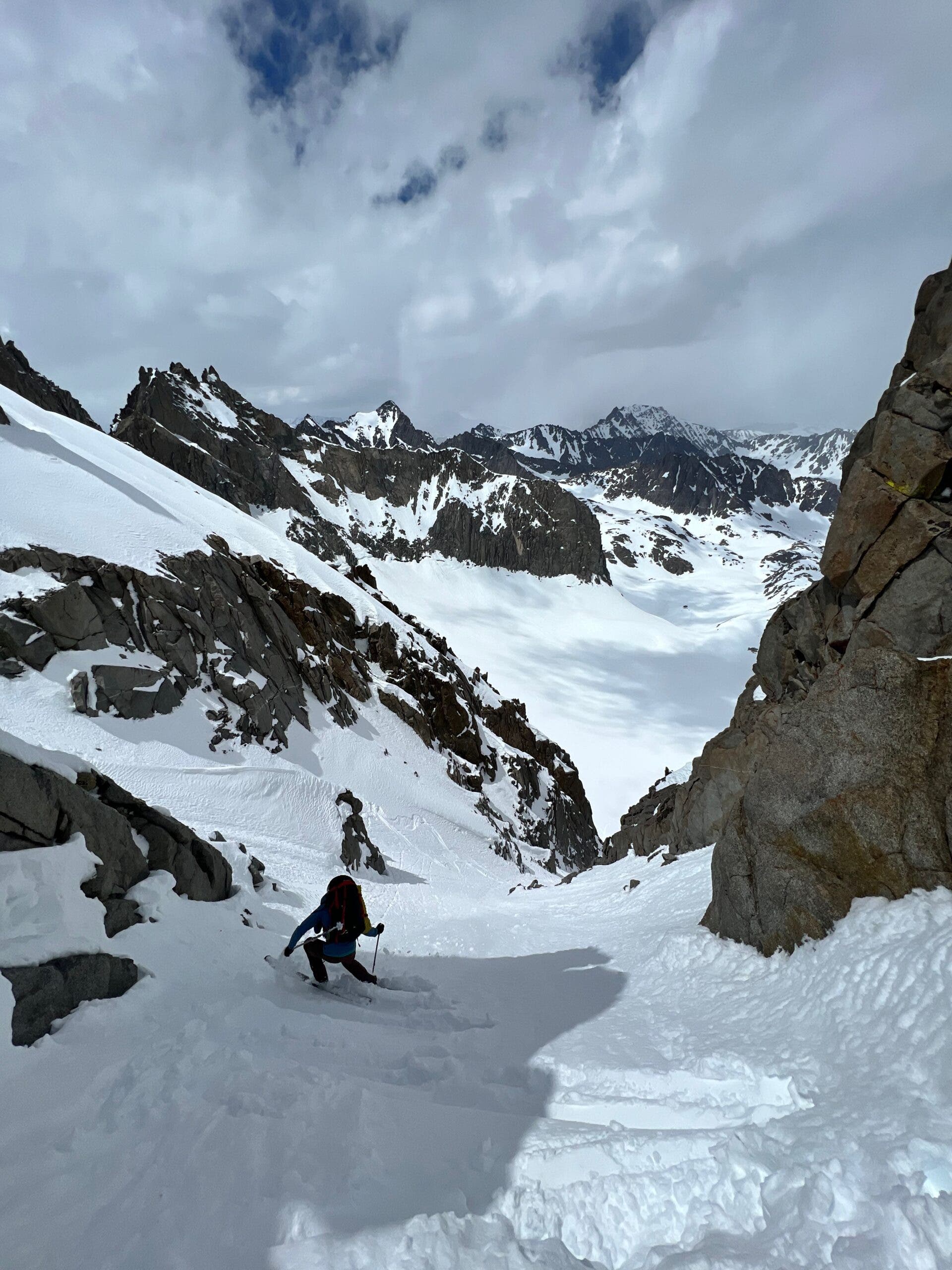
Despite being in an accessible range like the Eastern Sierra, the Redline has not been an oft-repeated effort. This is largely due to the Sierra feast-or-famine storm cycles. Many years, there simply isn’t enough snow to take such a high line through the range on skis. The 2016-’17 winter was one of a handful when the conditions lined up, and Bishop, Calif,–based guide Jed Porter was ready to pounce.
Porter describes the Redline as having “near-mythical status” among locals, and being mapped out by the founders “with the poetry of vision rather than the prose of prescription.” Porter saw the original 20 peaks they tagged and raised them 25, but also felt comfortable leaving the crest for better skiing. The most notable difference between Porter’s Redline and the original was that he was the first to do it continuously, skiing 125 miles and over 79,000 vertical feet in 16 days. Porter traveled mostly solo, with friends joining for short portions along the way. For Porter, style had to do with both aesthetics and community—“creative route selection and respect for the history of the endeavor and the ethics of recreational mountain travel.”
In some respects, his Redline was beyond what the founders did, with more peaks, fewer companions, and no rest days. Yet, he also had the benefits of modern lightweight skimo gear and technology such as digital topo maps and satellite communication devices. The metrics for comparing such fundamentally different experiences are difficult to parse. Porter wonders what future iterations of the traverse might look like, indicating “there’s still a lot of room to grow.”
A Tale of Two Missions
Kane and Cunningham’s intuition began to tingle sometime amid the 2022-’23 season. As a Kirkwood Mountain freeride coach and ski patroller/avalanche forecaster, respectively, Kane and Cunningham are on snow everyday, and could tell that that winter was different. Having put in their time in the Sierra on multi-day missions and smaller traverses already, they knew this could be the opportunity for something bigger. “We didn’t start out thinking we were going to ski the Redline. We just wanted to do something that would honor this incredible season,” Cunningham says.
The allure of the Redline to longtime Californians is powerful—and not just because of its elusivity. Kane describes the skiing itself as a central draw: “You’re completely immersed in the mountains for three weeks, skiing all day. That is kind of a dream.” And the spring of 2023 was, quite simply, “the right place at the right time,” Cunningham says.
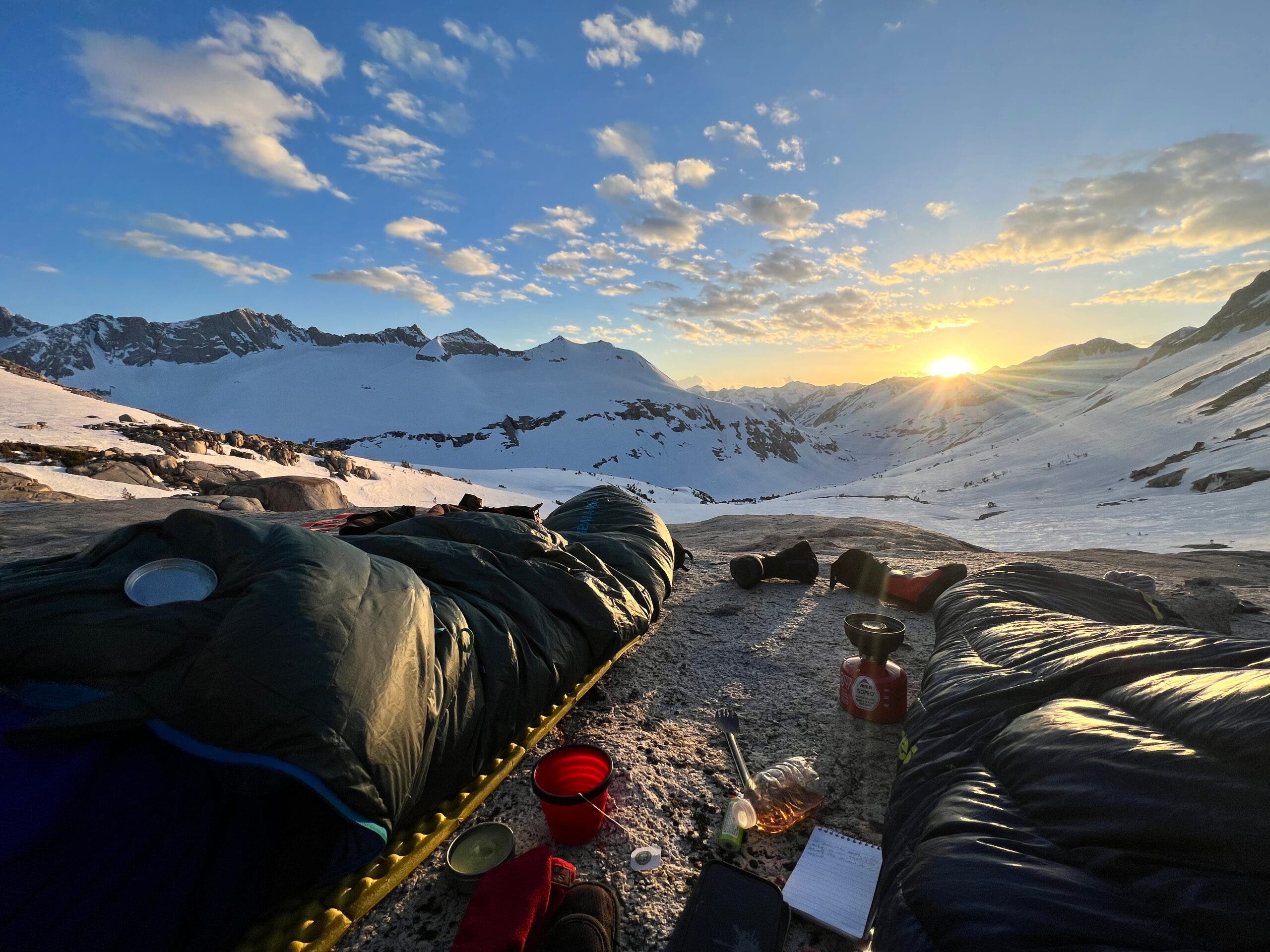
Despite the hazy definition, doing the Redline in good style felt critical to Kane and Cunningham. To them, this meant honoring the founders, staying above 11,000 feet, and skiing up and over the peaks. “I think the way you draw the line is your style,” Kane says. Cunningham was hopeful they would leave their mark on it, continuing to up the ante a little bit.
Meanwhile, in Salt Lake City, grad student Spencer Dillon was poring over Google Earth instead of paying attention in class. It had been an arduous year of keeping his nose to the academic grindstone, and Dillon was ready for a different kind of self-inflicted suffering. He was hoping to put his own stamp on the traverse by extending the finish line to Bridgeport, about 40 miles north of Mammoth. “The Redline was my little carrot to make it through the school year,” he says.
Dillon had roped in Matt Skorina, a friend from guiding on Mt. Shasta, to accompany him on his grand adventure. Skorina happened to be coming straight from a months-long stint on a research submarine in the Galapagos—not exactly ideal conditioning for ski touring above 11,000 feet. Unlike Kane and Cunningham, who were equally committed to the Redline, Skorina “really did this as a favor to me,” Dillon says, acknowledging that Skorina cared more about “skiing the logical line for our conditions and our bodies.”
Despite these differences in perspective and training, Dillon was chomping at the bit to ski the Redline to the letter while it was in—something that hadn’t happened many times historically, and was almost certainly going to decrease in frequency with the onset of more severe climate effects.
As fate would have it, both parties set out within a couple days of each other in May, but would end up drawing very different lines across the range.
A Route of One’s Own
When Bard, Carter, and Cox completed the original Redline, there were no GPX files (route files you can upload to map apps like Gaia) to save or post. They skied their Redline without tracking devices, sharing a few shots of film and sparse words of description.
By the time Porter completed his Redline in 2017, researching and recording adventures had changed significantly. A backcountry ski guidebook for the Eastern Sierra was published in 2009. It was now common for trip reports to be posted in online blogs, lines to be blown up on social media, and exact routes to be uploaded to Strava. This exponential increase in information made it easier than ever to research before skiing, and it also removed a bit of the raw adventure.
The vague instructions left by the Redline’s founders informed Porter’s approach to sharing beta. He published a trip report with photos and an elevation profile, but stopped short of sharing the full route. He did offer the GPX file to Kane, Cunningham, and Dillon, who all elected to do their own planning and navigation.
Dillon believes in the magic that comes with maintaining some mystery: “If you read the beta blow by blow, it takes the sparkle away,” he says. “You don’t get to have your own experience because it becomes mediated by ‘I’m not skiing the line that someone else skied.’” He thinks that figuring it out yourself combats “the malaise of comparison in the outdoor world and liberates people to have their own fun.”
Withholding information in the outdoors does bring up issues of gatekeeping. Skiing continues to be overwhelmingly white and male, and the field of Redline skiers is no exception—Kane is the first woman to complete the Redline, and all of its known finishers are white. Posting the exact Redline route alone, though, will not solve skiing’s inequities. Dillon thinks that to make skiing more inclusive, we need to deal with these issues at the root, providing more access into the ski world beginning at the entry level and true mentorship beyond a map. Kane agrees that being prepared for an endeavor like this requires so much more than just a GPX file. She and Cunningham are happy to share beta with anyone who asks for it.
“The goal is not for it to remain forever a secret,” Porter says, “I hope our abilities and creative capacities for mountain endeavors will increase faster than information gets out there.”
An Undesirable Detour
Six days in, Kane and Cunningham feel lightyears away from the cold powder of Mt. Whitney. It is now mid-May, and the weather has started to shift, the snowpack getting sloppier. They are tired from bagging an extra peak the day before, which has set them behind schedule. They posthole up the south side of a ridge that transects the crest and are greeted by a harrowing sight: cliffs with no skiable way down. It’s possible there’s an unseen route closer to the crest, but it would take considerable time and energy to get there. They are aware that with each passing minute, the sun presses down on the snow, making wet avalanches likelier and passage more dangerous.
Kane and Cunningham are not just partners in skiing, but also in life. It takes only a shared look to know that the way out of this is to descend below 11,000 feet, betraying a tenet of the Redline. Cunningham, typically stoic and steady, visibly sags. He has shouldered the weight of long days and a heavy pack, and it is this moment that cracks him. Heartbroken, they descend only half a mile and 500 vertical feet, but in their eyes, it taints the purity of the Redline. Kane steps up to carry the team, breaking trail for 2,000 vertical feet up to Darwin Col, where they continue forward.
Separate, Yet Equal?
There are endless options for crossing the Sierra on skis. The John Muir Trail, a popular backpacking route, parallels the Redline at a much lower elevation, and there are dozens of variations one could make in between. There will inevitably be a point where a Redline effort is actually closer to the JMT. So when exactly does the Redline become something else?
Despite setting the parameters for the Redline, the founders don’t seem too concerned with others sticking to them. Redline pioneer Tom Carter weighed in in Flylow’s 2023 film, The Redline Traverse: 40 Years on the Sierra’s Highest Route, about Kane and Cunningham’s effort: “It’s not just about checking the boxes or making it to whatever slope. So much of it is letting the spirit of the range [inform] the plan.”
Porter takes an egalitarian stance: “It’s mainly an act of creativity. There’s something in it for everyone—you can make it as rowdy or as mellow as you want.” He admits that his is a position of relative stability, as no one is questioning whether or not his Redline counts. Porter doesn’t distinguish between the Redline Traverse and a Redline–inspired experience, because “there is no one Redline Traverse. There’s no record of it.”
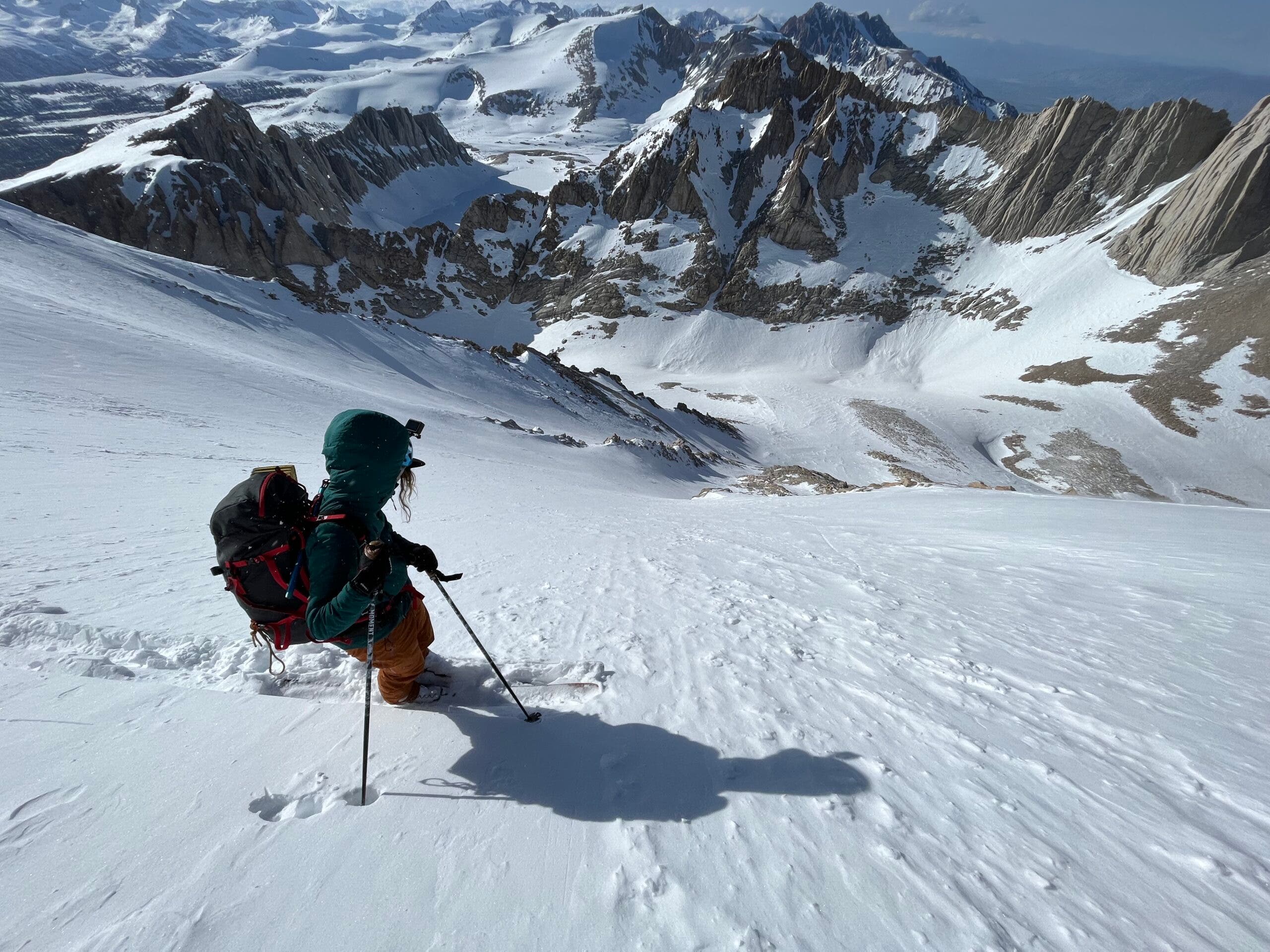
Kane isn’t sure about leaving the Redline so open to interpretation. She and Cunningham tried hard to adhere to the sparse criteria left by the founders: traveling within a mile of the crest, staying above 11,000 feet, skiing the peaks named in the 1984 Powder article. To allow for Redlines that ignore those boundaries feels like it dilutes the meaning and diminishes what they’ve accomplished. For them, style feels intricately connected with reverence for the Sierra, the history of the traverse, and its forebears. In the end, they skied 19 days, 145 miles, over 80,000 vertical feet, 26 peaks (with 15 summits), and 28 ski lines from Mt. Langley to Mammoth.
The numbers, of course, are only one metric.
Spencer Dillon set out planning to stay tight to the Redline. But from the jump, he struggled with the nagging guilt of deviation. After starting off with Mt. Langley, they skipped Whitney and Russell, two of the primary pearls named in the Powder article. Then, Dillon recounts, “we’re way out at the JMT, and suddenly Mt. Williamson seems really far away.”
For Dillon, these detours felt devastating, which he admits is partly due to his own issues with dissatisfaction and maximization, and partially due to the true scarcity of this route. He struggled with comparing himself “in a vacuum, because we weren’t skiing the highest line, and didn’t know exactly what other folks did.” After these initial days of disappointment, though, Dillon realized that he was “ruining his own experience by being grumpy,” and managed to mentally course-correct for the remainder of the expedition.
Looking back on it months later, Dillon is able to distance himself from the rawness. “We started skiing unnamed stuff to the west and I was like, this is really cool,” he says. “This is the adventure I wanted to have.” All in all, they were out for 16 days, skied 160 miles, 70,000 vertical feet, and a dozen or so big lines. Next time, Dillon muses, he will go all the way to Bridgeport.
So what counts? Porter asserts that “in the end, for the history book, [the details] kind of matter. For the individual effort, it doesn’t.” Dillon agrees that there seems to be a line between redlining the fun meter for yourself, and claiming something that exists in our collective consciousness. “I think we all have a gut sense of when we’re lying to ourselves about what we’ve done,” Dillon says, “At a certain point you have to be honest about what the community thinks is a thing, right?”
My college poetry professor said that translation is all about communicating the gesture and spirit of the words, rather than converting each one literally. The translation of the ’80s Redline to the modern versions is complex, perhaps more mystical than mathematical. Each skier did the Redline the way that felt best and most logical to them, and no one took the same exact route. We will never be able to entirely replicate someone else’s experience, and perhaps we’re not meant to.
The End is Just the Beginning
On their last full day, Kane and Cunningham hit their stride. They are in the flow of navigating the peaks and passes of the Sierra, the highs and lows of team decision-making. On the agenda are two iconic lines—Red Slate Couloir and Bloody Couloir. Each is a mission on its own, but it’s a reasonable twofer after nearly three weeks in the mountains.
They split a pouch of dehydrated biscuits and gravy at camp, waiting until the sun crests the ridge to begin. This day is singular, heady—the last one where they’re still completely in it. Tomorrow will pull them inexorably toward pavement. Tomorrow, they will not fall asleep in the mountains. Tomorrow, it will be over.
But for now, they revel in the blindingly blue sky above, the soft snow beneath their skis, the feeling in their chests. Kane and Cunningham are not in this to finish it, not ready for it to be done. They embarked on this traverse for the experience, for each moment in the middle, for the cumulative effect of weeks in the wild. For today, they get to linger here a moment longer.
Behind them, sprawling across the Range of Light are the invisible, glowing threads of Redlines past and future, the exact contours of which are known only to those who made them.
It is just as Tom Carter told them: “If you go there, you get that intimacy, that enchantment of just being in the mountains covered in snow. All those shadows, all that texture. Don’t cut yourself off from that experience. It’ll knock you out.”