Published May 7, 2026 07:00AM
When we arrived at the Alta Lodge for our family ski trip, it took me 20 minutes to shovel a pair of parking spots out of the snow. What looked like a nearby snowdrift was a car buried four feet deep.
It was a fitting start. Utah’s Alta Ski Area is legendary for snowfalls so prodigious that guests can’t leave the resort for days. Yes as much as I love fresh snow, I wasn’t looking to extend our trip. Rather, the point was a metaphorical excavation of my relationship with my mom.
Mom turned 85 this year and didn’t buy a season pass for the first time in decades. It was understandable—she’d shrunk to about 100 pounds and in recent years suffered two separate pelvis fractures. I hated to see her give it up. Skiing had revitalized her in middle age, to the point where people have long stopped me in public to marvel at her. “Your tiny mom is such an inspiration,” they’d say, and then describe some powder day or 10-mile cross-country ski where she’d dusted them.
To get her back on the slopes I proposed a trip to Alta, a mountain she’d wanted to ski since her 20s. Alta famously lets guests over 80 ski free, and staying slopeside in the high alpine valley of Little Cottonwood Canyon is one of American skiing’s peak experiences. Nonetheless, the bigger draw for my mom was the chance to spend time with our two-year-old, Leif.
While I shoveled, Dad and my wife, Eve, hauled the luggage inside through the sideways blowing snowfall. Mom held Leif’s hand as he toddled into the lodge.
My parents met on a ski trip to Oregon’s Timberline Lodge. Not much skiing was done. A blizzard so strong raged that weekend that most of the guests, my parents included, sheltered in the lodge, playing cards and drinking. On Sunday, after unearthing her friend’s car, they drove home to Seattle, and she told her roommate she was glad she’d never have to see anyone from that weekend again because she had drank so much. My father says they danced together on the bar in the Blue Ox saloon, in the Lodge’s basement. “I don’t remember that,” Mom always says.
Dad did come calling, of course. For their first Christmas together, he bought her a pair of four-buckle ski boots, and they often night-skied at Snoqualmie Pass. After I was born, though, they spent two decades in Mississippi near my dad’s family. It was a sort of purgatory for mom, chafing against the Victorian southern culture. In many of my childhood memories, she is grim-faced.
That changed when they moved to Jackson Hole when mom turned 50. On her days off, she’d log 20-mile day hikes in summer, and in winter she joined weekly women’s ski groups with nicknames like Chicks on Sticks and the Hot Flashes, a wry nod to the perimenopause settling on nearly every group member. Eventually my dad couldn’t keep up with her on foot or on skis. These days she has three different regular hiking groups: slow, fast, and medium, and she’s the oldest member of each. Though Mom and I have so much in common—a love of reading, an absentminded temperament, and a zeal for skiing—her mountain renaissance didn’t bring us much closer.
I was 11 years old when my parents sent me away to boarding school. My younger siblings stayed home, and it was impossible not to feel exiled. I spent long nights in a dorm room cot, curled up, mourning.
I never understood why I’d been sent away. They’d told me it had been at the suggestion of a psychiatrist, but if there was an explanation for his directive, I don’t remember hearing it. In the years after I was sent off I hadn’t wanted to ask. It was easier to keep my emotional distance and let time drift over my resentment.
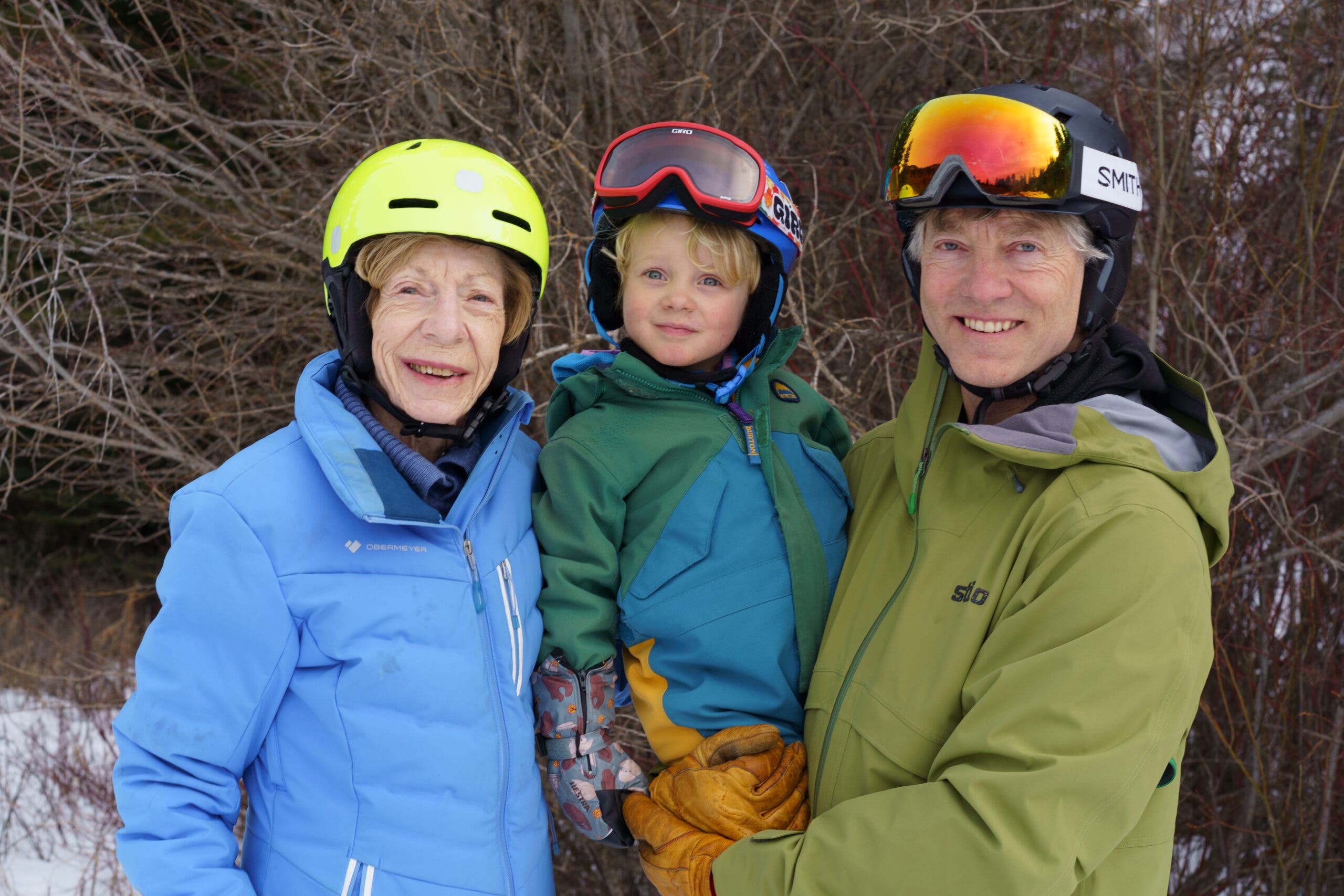
After I parked the cars, I found Leif in his grandparent’s room, laughing with delight. They were all three lounging on the king-size bed, fashioning mustaches out of the Play-Doh the lodge issues each young guest. His joy with my parents was a wonder to me, and it gave me confidence for the hard conversations I had planned. Outside the window, the sun was setting, painting the canyon walls and low clouds a ruddy orange.
At dinner, Leif ran wild. He fled his highchair and ran into the lobby. He ran downstairs to the ski lockers. He ran back upstairs and climbed the arm of a couch and stared at a man sitting there. “I’m two!” he shouted. Leading him back into the dining room, Leif shook my grasp and approached another toddler, roaring like a T-Rex.
Growing up, my parents were militant about table manners. Elbows off the table, sit still, ask to be excused, but not before finishing your entire meal. Many nights I ended up alone at the table gnawing dejectedly on cold meat. Decades later I watched my parents wage uncomfortable mealtime power struggles with my brother’s young kids. Yet at Alta, they just smiled at Leif’s antics, even at breakfast when he pegged Dad in the chest with a chunk of cantaloupe.
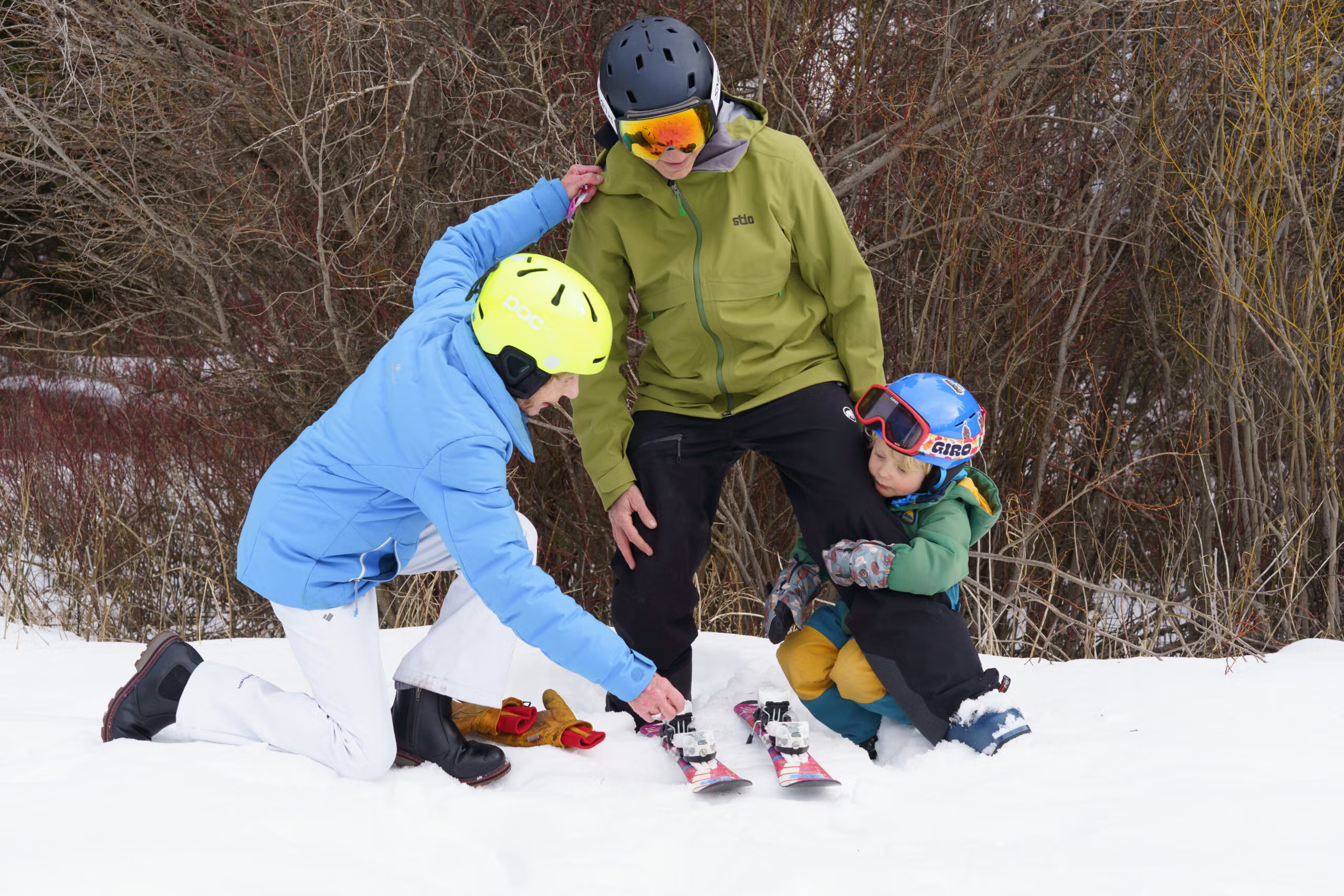
In the morning, Mom and I finally headed out for a few runs, clicking into our skis out the lodge’s slopeside entrance in a few inches of fresh snow. The doctor had only recently cleared her to ski, so we started on the flats, amongst the three-year-olds. On skis she was unsteady, and couldn’t seem to turn left, at one point crumpling to the snow just before she hit the archway covering the magic carpet. I held my breath on every turn lest she hurt herself again, as I’m sure she had watched me struggle to learn to walk, run, and ride a bike. I wondered if we’d even make it onto the mountain.
After about 20 minutes of practice, she looked a lot better. We caught a chairlift to the intermediate terrain. I stared down at our skis dangling over the slopes below, skiers schussing beneath us, and mustered the question I’d been putting off for years.
“Why did you send me away?”
I think she’d been waiting a long time for the question, because she started her answer further back than I expected, with my alcoholic grandfathers. “When my father drank, he was very abusive to my mother, not physically, but verbally,” she said. “It completely undermined her confidence.” I knew that my mother’s resentment towards her father was why we hadn’t been close to her parents growing up. As for my paternal grandfather, he’d died before I was born. Dad has described sweeping handfuls of unknown pills from his desk drawer into the trash.
“Your father and I learned that children of alcoholics often end up married to each other,” Mom said. I knew that part of our family history, remembering the Adult Children of Alcoholics meetings they’d attended. She explained that children of alcoholics tend to like controlled homes, reactions to the chaotic environments where they were raised. I’d been reacting to that tight control my whole life, at the dinner table and beyond. Eve says that my habitual lateness, except where skiing is concerned, is one of my many subconscious protests against it.
“When you were in fifth grade,” Mom went on, “your homeroom teacher called me.” Your child is completely isolated from the other kids, she’d said. He isn’t bullied, he just doesn’t engage with them. I remember standing with my back against a fence during recess, too intimidated to approach the other kids. And I recall being scolded for chewing my shirt collars into soggy wads from anxiety.
Then, sitting side-by-side with the chairlift rising above the face of a snowy cliff, she said the part I didn’t know: The psychiatrist told my parents that mom’s behavior was the cause. “He said it was something I was doing to you.”
I connected the dots. Sending me away was better than the alternative, they must have determined, which was exerting too much control, and also holding a chaotic child—me—at arm’s length when they were overwhelmed by raising two younger kids. “He said we needed to get you out of the house as soon as possible,” she said. I could hear how much it hurt her even 40 years later.
What I hadn’t known was that my parents had struggled against the psychiatrist’s advice. They’d petitioned for one more year at home, but he was insistent. “I cried for weeks,” she said.
When we got to the top, I led mom down a cruisy blue run called Rock and Roll. I think we were both relieved to have a break in the intense discussion, each of us used to a lifetime of the rhythms of ski resorts—alternating skiing and chairlift conversation.
Snow was falling from low clouds making it hard to see, so I skied slowly and glanced frequently back over my shoulder, only to see her slaloming back and forth with a wide smile beneath her goggles. At one point, I stopped to give her a break, but she went flying past and up onto a hillock of soft snow. She fell slowly backwards, her skis in the air. She was laughing when I got there and I picked her up under the armpits, like I do when Leif falls, and set her on her feet. “Oh, I’m having such a good time,” she said.
Back on the Supreme chairlift, I said how impressed I’d been when Dad didn’t react to getting hit by Leif’s thrown cantaloupe. “He’s learning,” she said. “We’re both learning.”
On the next run, Big Dipper, I led her towards a patch of untracked powder along the side of the trail and let my skis run, feeling the float. Behind me, mom let out a happy whoop, as though she were 20 years old.
Finally, the blizzard of static I’d felt every time I spent time with my mom finally subsided.