Updated March 12, 2026 09:51AM
In the scenario that you survive an avalanche burial, can you imagine a sight more uplifting than that of a dog muzzle shoving through the darkness to your rescue?
Anyone buried in an avalanche dog training drill knows this well. Only, instead of waiting in the drill’s safe, dug-out underground space, in a real-life avalanche, you’d have been tumbled, smashed, and cemented into the blackness, hopefully with hands over your nose and mouth to create an air pocket so you would be able to last long enough to hear the vibrations of a dog digging and scratching overhead and see that muzzle popping through.
Alas, in his 35-plus years of searching for buried avalanche victims, John Reller has found zero alive. Nonetheless, he believes his chances of doing so are much better when dogs are involved.
About a quarter of avalanche victims die before they’re buried due to trauma from impact and/or debris, but most suffocate during and after burial. Although there are many variables, including how deep they’re buried and whether they have space to breathe, according to the Utah Avalanche Center, about 90 percent of avalanche victims survive if rescued within 15 minutes.
Of all the tools created with the goal of increasing the odds of surviving an avalanche or finding victims—state-of-the-art transceivers, RECCO chips, airbags—there has been no apparatus that measures up to the power of a dog’s nose.
“There’s no technology that can replace that,” Reller says. “Transceivers have done a hell of a job. By far your best chance of survival is companion rescue. If you’re waiting for someone to arrive, you’ve probably already used up the survival window. But the way these dogs pick up scent is incredible.”
A patroller at Copper Mountain in the late 1980s, John started working in search and rescue and the local Sheriff’s Office, both of which had been using a dog or two for searches over the years. Then, a large slide killed four skiers on Breckenridge’s Peak 7, which was a backcountry area at the time. That raised a red flag about the need for search dogs on ski patrol.
After Reller and his wife, Andrea, got married in 1990, they got their own avalanche dog, Skadee—the first of a string of female golden retrievers—and began organizing avalanche dog training under the name of Colorado Rapid Avalanche Deployment (C-RAD). The nonprofit organization, which won the 2025 Colorado Snowsports Hall of Fame Top of the Hill Award, trains and tests avalanche dogs throughout Colorado and the surrounding states. Over the last several years, a C-RAD-validated dog and handler team has become the gold standard for avalanche search missions.
“If the Sheriff’s Office is calling a C-RAD dog team, they know they have a certain level of competency and professionalism they can trust,” says John Alfond, Dog Program Leader at Vail Mountain Ski Patrol. “They can say, OK, these guys are validated? They’re good to go.”
A sample search
A C-RAD validation drill provides an impressive glimpse of an avalanche dog’s capabilities. At Vail this February, a Summit County Rescue Group dog and handler team as well as five teams from a variety of Colorado ski resort patrol squads put their skills to the test. (Patrol dogs are not allowed to be validated on their home mountain because unfamiliarity with terrain is imperative for real-life avalanche rescues.)
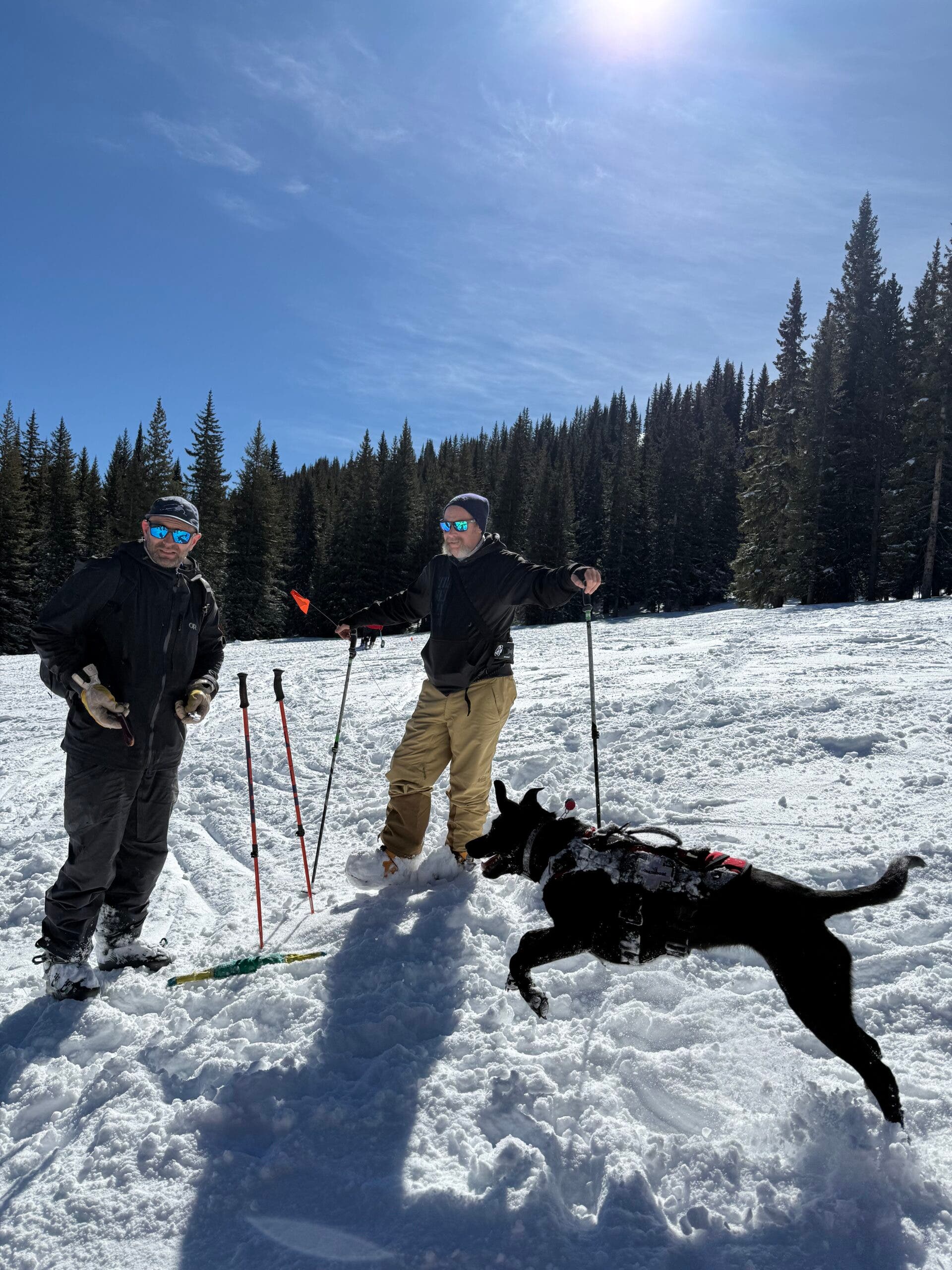
Arriving into a 100-square-meter zone on the mountain, each dog and handler had 20 minutes to find one to three people buried under the snow. Daisy, a 4-year-old black lab on Steamboat Resort’s Ski Patrol, leapt wildly in the air in anticipation of racing into the zone. Upon her handler, Chad Feagler, giving the signal, she bolted around the slope with her nose to the snow, tail wagging wildly. She found her first target in less than 30 seconds, the second, buried about 80 feet away, about a minute and a half later.
“Watching the dogs, you have to be like, ‘they didn’t know beforehand where this person was buried?,’ says Chrissie Oken, an avalanche technician on Vail’s ski patrol. “They’ll catch a scent, do a 180 and b-line it to where the person is buried. It’s amazing.”
Searching for avalanche victims, in a drill or in real life, is nothing more than “a game of hide and seek” for avalanche dogs, Reller says, adding that there is a certain “type” of dog best-suited for the work (retrievers, labradors. and herding breeds are at the top of his list).
“As puppies, these are dogs that have a higher drive, an independent drive. They’re not just playing with the litter. They have a confidence, an inquisitiveness to them,” he says. “Dogs we’re looking for are potentially the more challenging ones at home. They need more exercise, more direction.”
Good for morale—and marketing
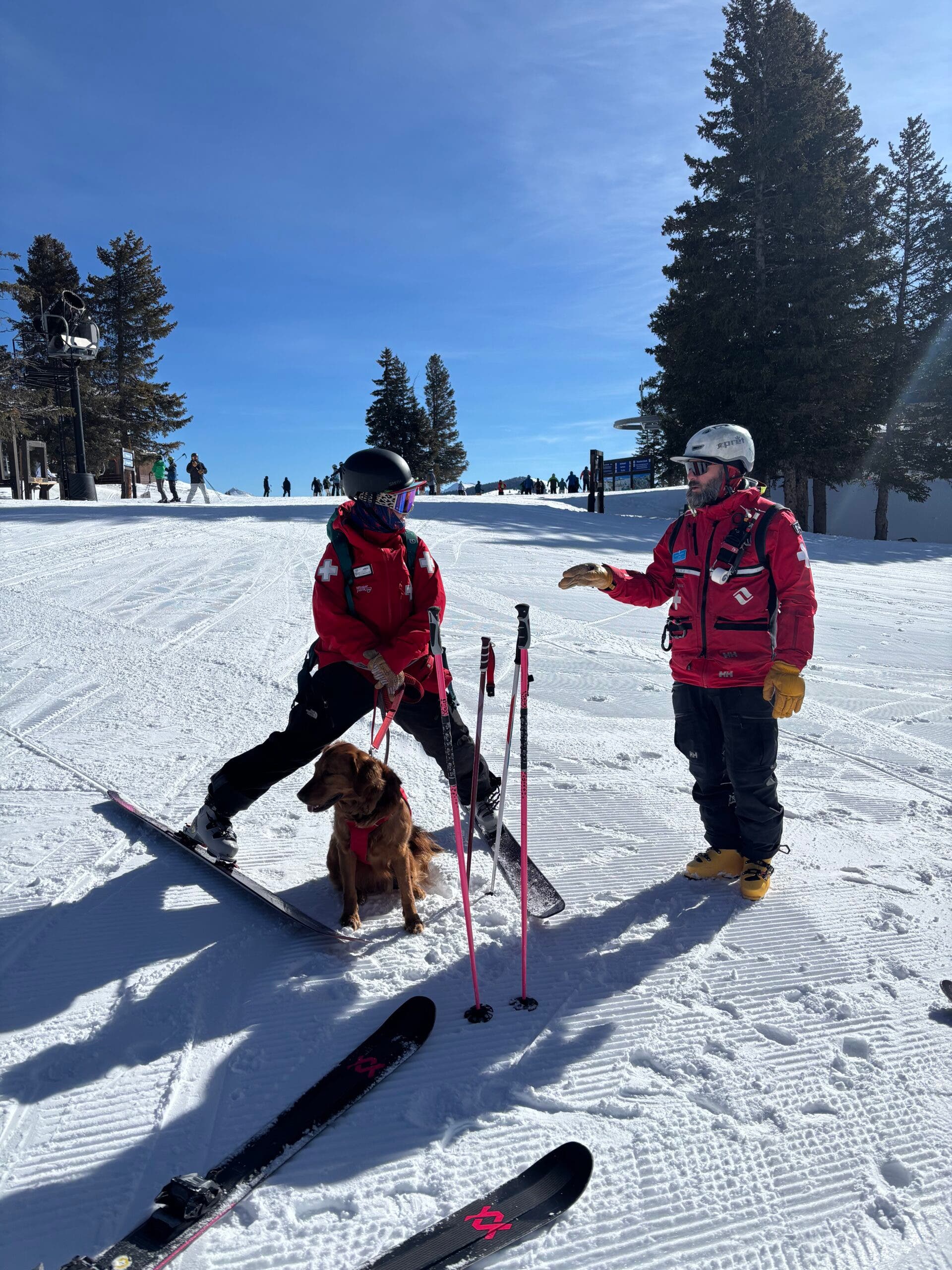
Other than possessing great noses for their main job of searching for people in case of an avalanche, ski patrol dogs hold a solid role as resort mascots. Vail’s Dine with the Dogs—a free hour-long event introducing patrol dogs to guests every Sunday—typically draws 80 to 200 people.
“The dogs are there in case something happens in resort boundaries or right outside,” Andrea Reller says. “They also use them for advertisements. They definitely play a marketing part.”
For Copper Mountain Patroller Nick Slaton, the most rewarding work with his 6-year-old C-RAD-validated golden retriever, Nevé, is “the day to day.”
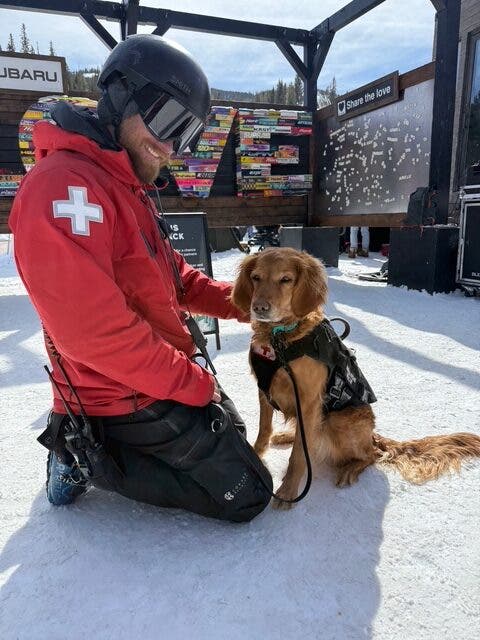
“Being able to bring my girl to work—she goes everywhere with me—that’s the best,” he says, while leading Nevé through a throng of fawning children during a Copper Patrol Dog “Meet and Greet” at Subaru Winterfest this February. “I can’t tell you how nice it is when I get back to the duty station and she’s just cuddled up on the couch with my coworkers. As soon as I grab the vest, she’ll be up and at it and ready to go play that game. Just that continued bond between us that keeps building all the time is rewarding.”
“They’re so happy,” Oken agrees. “Patrolling is hard. It’s draining. It’s fun to work with that energy. It brings everyone up.”
The tight bond between avalanche dog and handler is the most critical component for successful searches.
“If we’ve done our training appropriately, the dog has already started working. They’ve started smelling, looking for scent,” Reller says. “It’s working together with purposeful movements. Some dogs have a longer range. Some want to work closer to their handler. A lot of avalanche dog searches involve reading your dog’s body language. Knowing she’s in scent, what the ears do or how the tail wags.”
Last winter, a group deployed to search for a snowmobiler buried in an avalanche on Vail Pass. Even before the avy dogs got a chance to pick up a scent, a rescuer caught sight of a piece of fabric on top of the snow. It was the guy’s airbag. He was attached to it, alive, his helmet having created an air pocket.
The reality of the find
“It doesn’t matter how the person was found. A live find is a cool experience for us,” says Ben Butler, who along with his black lab, Hoggle, works with Summit County Rescue Group. John Reller was thrilled to hear the news after so many decades of body recoveries.
“We call them rescues, but nobody talks about what we typically are going to do,” Reller says, adding that he still feels purpose and gratification in providing closure for victims’ loved ones.
Although they didn’t end in saving lives, his most meaningful experiences with his avalanche dogs over the years have been deeply emotional. He recalls one of his earliest missions with Skadee, in which he was dropped into a half-mile slide path by helicopter to search for a buried snowmobiler. A team of rescuers, friends, and family were on scene, including the victim’s wife. It was Reller who spotted a glove sticking out of the snow, which, it turns out, was attached to the buried man.
“The wife came over, dropped down, understandably crying. There was something else, though. I was like, what’s that noise? It was Skadee mimicking that wailing sound. That’s why we have emotional support dogs, because they recognize that emotion.”
The importance of reward
Rewards are a key component in keeping avy dogs motivated to do what they do. During search drills and tests, the handler and sometimes the person buried shower dogs with praise and playtime when they make a find. For Baylee Rice, who leads the dog program at Copper Mountain Patrol, celebrating a job well done with her black lab, Lillie, delivers her most heart-soaring moments.
“After we’ve done a hard drill or worked a tough scenario, I always let her win with a toy,” Rice says. “When she gets the toy, she runs around and looks so happy. When she lays down, she’ll drop the toy on her paws and look at me with a big smile. It’s like she knows she did such a good job and found what she was looking for. She’s done her job and now she’s like, ‘let’s play!’ It’s just the cutest.”