Updated April 29, 2026 01:57PM
Ken Lubin and Aaron Fudge are booting up Hillman’s Highway on the way to the start line and discussing how they’re going to deal with a section of boulders blocking their path down the rest of the race course. While Fudge seems to accept that he’ll have to take his skis off and traverse over the pile, Lubin eyes a path through dense shrubs that’s still covered in snow, debating if it’s possible to ski it.
The pair are racing in this year’s Tuckerman Inferno, a long-established race in the White Mountains of New Hampshire. First competed in 1933, the race has taken many different shapes and forms over the decades. This year however, the race returns to its original format—a summit-to-base descent down the rugged backcountry terrain of Mount Washington. At least, that’s the plan.
It turns out, though, the mountain has other ideas.
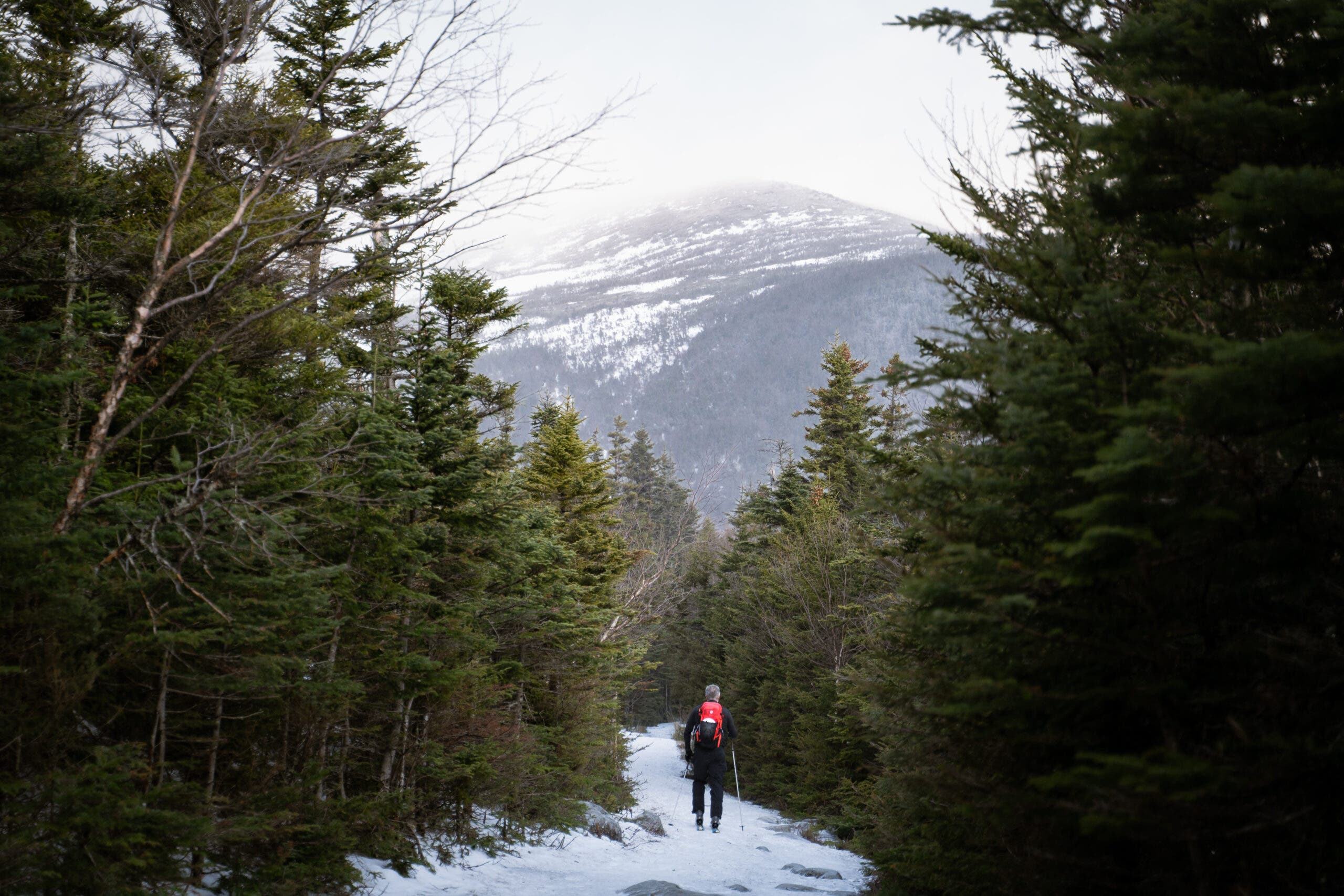
It’s just before 6 a.m. when Lubin sets out from Joe Dodge Lodge at Pinkham Notch, the primary gateway to the Tuckerman Ravine trail. His start time for the top-to-bottom race is 9:37 a.m., giving him just over four hours to make the 4,000-plus-foot climb to the summit of the mountain. At each landmark on the trail, he checks his time. “Usually I get here in 22 minutes,” he says as he passes a fork in the trail. “We’re at 27, so I think we’re still on pace.”
A former ski racer, Lubin is no stranger to the White Mountains or the Inferno Race—he spends nearly every weekend tooling around Mount Washington. That familiarity with the terrain helped him win the Inferno back in 2011, and podium multiple other times. After competing each year in the previous formats of the Inferno, which now serves as a fundraiser for the Mount Washington Avalanche Center Foundation, Lubin pushed race director Jake Risch to finally bring back the OG version of the race: a top-to-bottom slog designed to challenge the most determined athletes.
The Evolution of the Inferno
The Tuckerman Inferno has bobbed and weaved alongside skiing’s growth and evolution. As the sport’s popularity grew in the 1920s and ’30s, so did the prestige of Tuckerman Ravine. The Civilian Conservation Corps, established by President Roosevelt as a part of the New Deal, began cutting trails from Pinkham Notch, and Tuckerman Ravine became a proving ground for early extreme skiing in the United States.
Along with collegiate outing clubs from Harvard and Dartmouth, ski clubs in the area decided a formal test of skills was in order, and looked for a format that would identify the best skiers in the region. Taking inspiration from one of Europe’s most famous ski races, the Inferno race in Murren, Switzerland, they settled on a top-to-bottom route of Mount Washington that sent skiers down the upper snowfields, over the headwall of Tuckerman Ravine, and finally down the newly cut John Sherburne ski trail. The winning time was 14 minutes and 41 seconds. The race continued for the next six years, culminating in Toni Matt’s infamous record of six minutes and 29 seconds in 1939.
The race wasn’t run again until 1969, but weather limited the start to below the summit. The competition returned in the 2000s, but to encourage more participation, it took the form of a pentathlon. Racers would bike, cross-country ski, kayak, hike, and ski around a course that ran through the Mount Washington Valley.
This year, with the encouragement of Lubin, race director Jake Risch, whose father was instrumental in the resurgence of the race in the early 2000s, made the decision to shift the race back to the original format. “There’s so much history around here,” says Lubin. “It seemed like it was time to bring it back.”
Navigating Race Day Uncertainty and Severe Conditions
After about an hour on the Tuckerman Ravine Trail, Lubin reaches the Hermit Lake Shelters. The first competitor to hit this checkpoint, he’s greeted by a group of ski patrol volunteers and Risch, who’s been up scouting the conditions in the early hours of the morning. Hermit Lake is one of the first points where you get a view of the alpine terrain of Mount Washington, and one quick glance up the mountain made it obvious that the race organizers were trying to debate how to navigate the low visibility and 60 mph winds ripping across the upper terrain.
This year’s race had already been postponed due to weather. Originally scheduled for the middle of March, it was postponed to April 11 after an inch of rain that led to a flash freeze. As Lubin sat at Hermit Lake waiting for an update from race organizers, he lamented about how perfect the weather would have been just a day before. “The mountain dictates this race,” he said. “Not us.”
It’s almost impossible for someone to speak about Mount Washington without also bringing up the severe weather. The same conditions that make Tuckerman Ravine great for skiing—prominence, proximity to the coast, and a breeze that deposits snow into the bowl—also make for some of the most severe and unpredictable weather in the country despite the mountain’s relatively low elevation. Of the 161 recorded fatalities on the mountain, a significant majority of them are due to exposure or long sliding falls on icy conditions.
Part of the reason that people in the northeast are drawn to Mount Washington is because of the “self-torture of the shitty weather,” Lubin hypothesizes. “It turns what may normally just be backcountry skiing into full on mountaineering.”
Fudge, another competitor in the classic race, agrees. After recently returning to New Hampshire after eight years in Oregon, Fudge feels that these mountains hold up to the best of them on the West Coast. “It’s been amazing to relearn these mountains,” Fudge says, “and to understand how crazy these small mountains can actually be.”
The Course Pivot and Grueling Descent
About 30 minutes after sending a patroller up into the bowl, Risch’s radio rings out with an update. “I’m currently heading up Right Gully, kicking my crampons in as hard as I can, and barely making a mark.” After some sarcastic remarks about perfect conditions for breaking Toni Matt’s record, Fudge and Lubin quietly concede that the mountain will not allow for a summit descent this year.
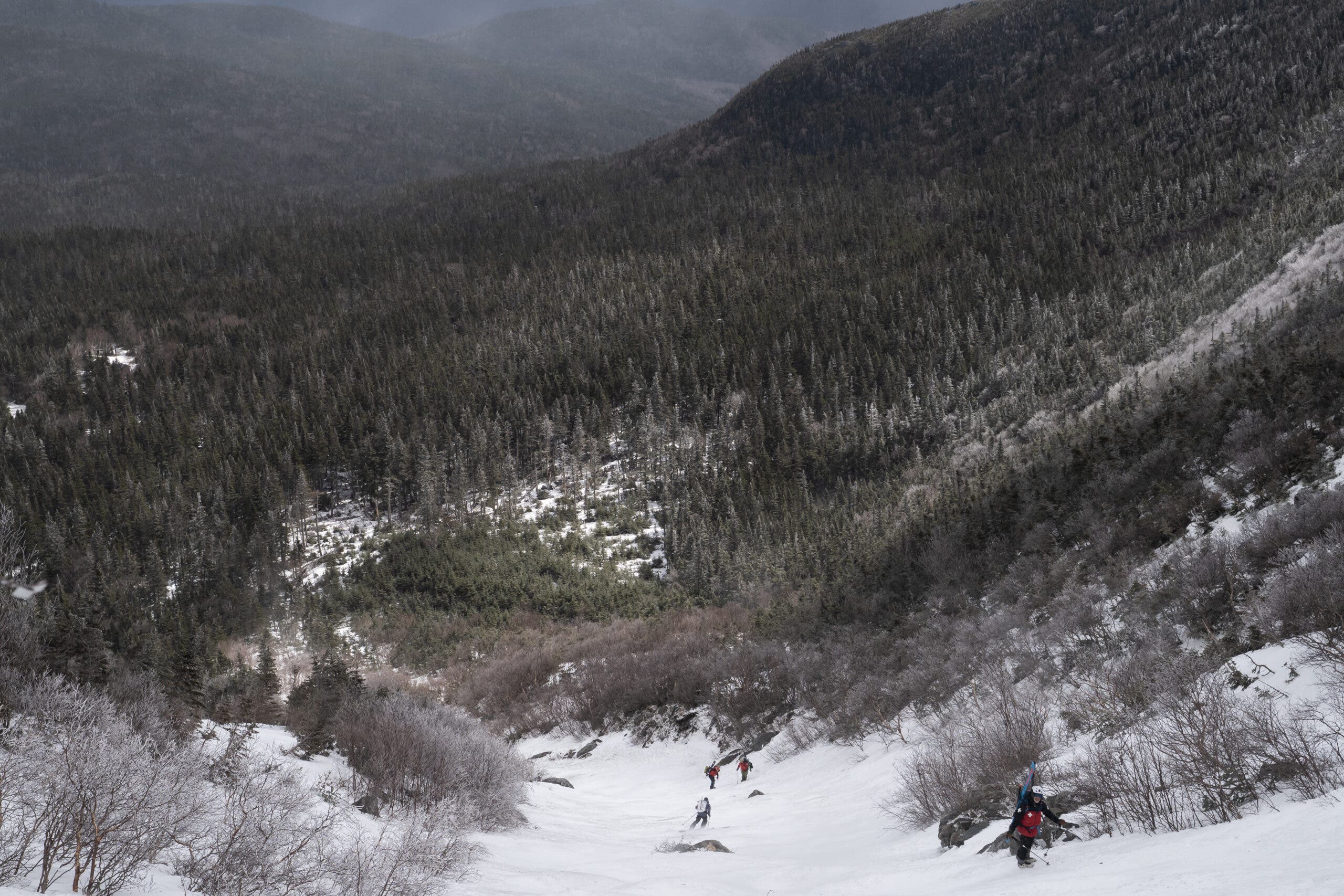
Risch and the other race volunteers, who actually outnumber the total racers competing, quickly make the pivot to sending the competitors down Hillman’s Highway, a 1,300 foot couloir outside of Tuckerman Ravine. Race organizers would set up a start line about halfway up the route, right at the edge of where visibility deteriorated, and racers would ski down the line and continue to the finish line on the John Sherburne Ski Trail.
After waiting nearly two hours, both Fudge and Lubin welcome the opportunity to get warm and finally continue on uphill. The two make their way to the base of the route, slap on their crampons, and begin the slow climb to the start line, stopping only to brace themselves against the gusts of wind blasting up the slope. Not only is the snow still firm and fast, but it’s formed into broad moguls that they would have to manage right from the start.
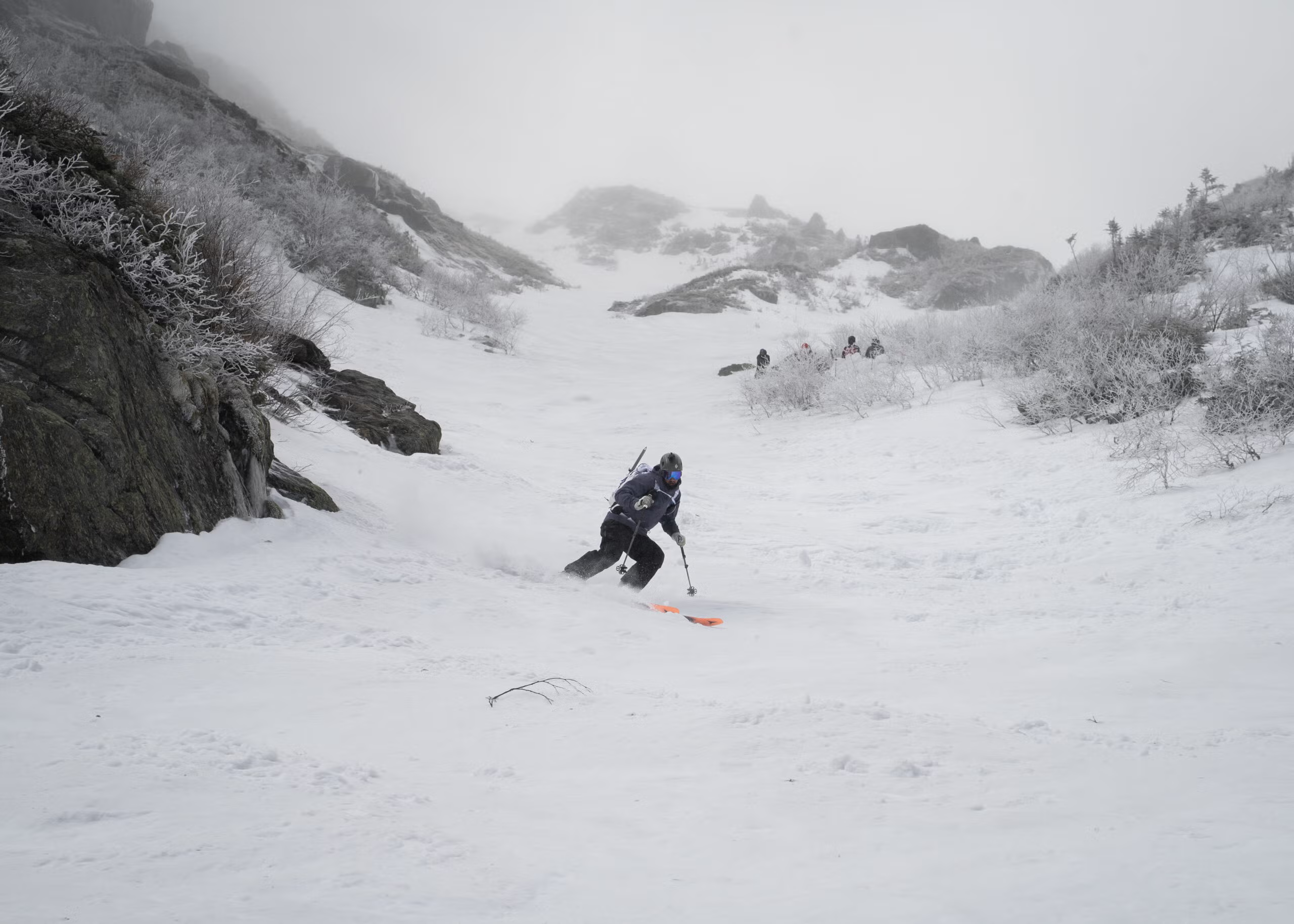
After reaching the start line, Lubin clips in, takes a look down the slope, and points his skis downhill. Trying to connect whatever edgeable snow he can, Lubin weaves his way down to the bottom of Hillman’s, removes his skis, jumps over the boulder pile, and disappears down the Sherburne Ski Trail. Just minutes later, Fudge takes off from the same spot, taking a more cautious approach to the icy conditions, safely navigating between the troughs of the bumps.
On the Sherburne Ski Trail, the pair navigate dry patches, rocks, streams, and a significant amount of mud. As they continue down, there’s often no choice but to remove their skis again and scurry past dry spots on the trail, and while the fate of their ski bases likely aren’t top-of-mind, their finishing times are.
After finally making it to the end of the trail and crossing the finish line, the two wait in suspense to compare their times.
- Aaron Fudge – 8:24.40
- Ken Lubin – 10:17.40
Slow and steady wins the race.
In the end though, the times felt beside the point. The course had changed, conditions shifted, and the race never quite matched the version drawn up on the whiteboard. But this, in many ways, is what the Inferno is all about.
Despite the chaos of the day, both racers consider the event to be a success. “The Classic Inferno is just that—classic” Fudge says. “It’s so cool to bring back the history of the race almost a hundred years later.”