
As an enormous winter storm looms off the coast of South America, a local ski resort, Valle Nevado, Chile, is making changes to its operating plans on the fly.
The multi-day storm cycle, which, per recent forecasts, could bring between 12 and 20 feet of snow to Valle Nevado over the next week or so, prompted Chile’s Ministry of Public Works to close Routes G-21 and G-251 on Wednesday evening, the primary access roads for Valle Nevado, according to a resort spokesperson.
The spokesperson added that the Ministry of Public Works plans to reopen the roads at 6 a.m. on Saturday, July 18, 2026, conditions permitting.
In response, Valle Nevado offered guests an early check-in option so they could reach the resort before the storm arrived and the roads closed. They also gave guests the option to apply what they paid as credits toward another visit.

Valle Nevado
In a social media post Thursday morning, Valle Nevado asked prospective visitors to “not begin your ascent, and stay tuned for official information regarding the situation.”
Despite the road closures, though, some of Valle Nevado’s lifts and ski runs remained open as of Thursday afternoon.
Earlier this week, Ski Portillo, another ski resort in central Chile, announced that it would close entirely with no set reopening date.
Many of South America’s ski resorts saw a slow start to the 2026 winter season, so the incoming storm presents a welcome and dramatic change of fortune. If the forecasts pan out, several mountains could have more snow coverage than they know what to do with, leapfrogging to the mid-season stage.
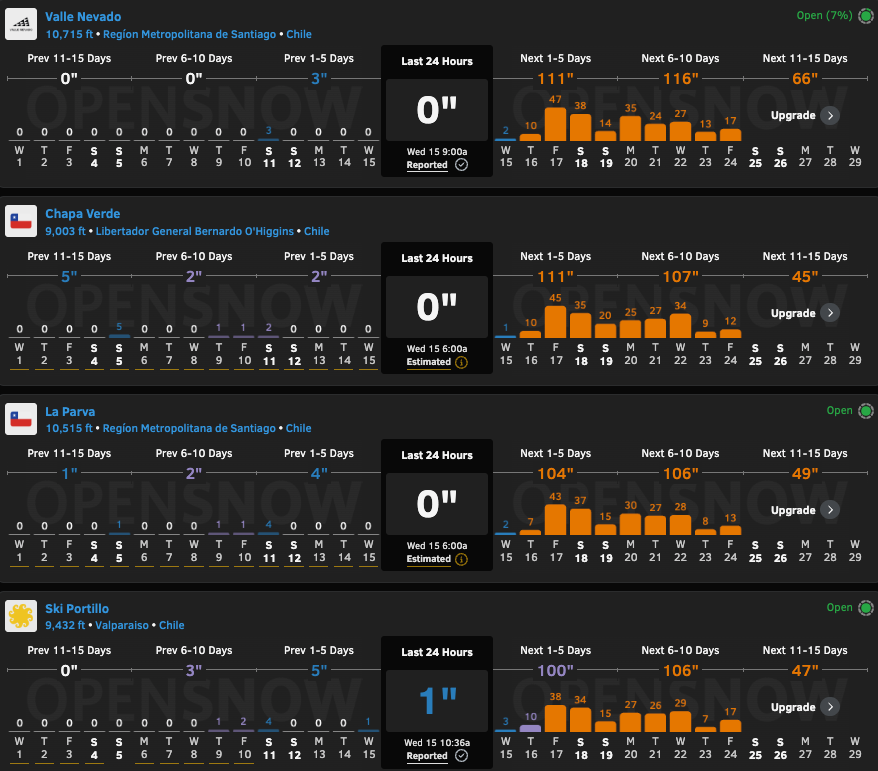
OpenSnow
But at a certain point, big storms can cause problems for ski resorts, at least temporarily. They snarl roads, rapidly elevate avalanche danger, and can lead to power outages.
It’s far from unheard of for ski resorts to pause operations amid a serious blizzard—such a thing as too much snow exists. This past ski season in the Northern Hemisphere, several California ski resorts temporarily shut down in February when heavy snowfall and strong winds slammed the Sierra Nevada.
Those impacts can extend beyond ski resorts as well.
This week, the Chilean government declared a preventative state of emergency in ten of its 16 regions. The procession of frontal systems is expected to bring an atmospheric river qualifying as a Category 5, the highest on the scale, United Press International reported.
In Santiago, the nation’s capital, as much as half of the average yearly rainfall could fall in just a few days, with authorities warning that the extreme weather raises the risk of widespread flooding and significant property damage.
“In the coming days, we will face a frontal system of great intensity,” wrote Chile’s president, José Antonio Kast, on X earlier this week. “We are deployed and coordinating all the necessary resources to protect Chilean families.”