Published August 19, 2026 10:27AM
When I got the phone call from an old friend who worked in marketing at K2’s headquarters in Seattle, Washington, my tone was as jaded as you’d expect from someone who’s been writing about ski gear for 25 years. “What do you mean, the first true women’s ski boot?” I asked. “Everyone makes women’s ski boots.”
Then, after planes, trains, and automobiles, standing in the boot development area of K2’s warehouse amidst shelves of prototypes, parts, and misfits, I understood. I held in my hand a 3-D print of the 2027 K2 Anthem, the first-ever boot fully designed in a mondopoint size (the industry’s standard measuring system) of 23.5. The first true women’s boot has arrived—and, not surprisingly, it came directly from the world’s first female boot engineer.
“We are the first brand to have done this in the history of ski boots,” said 29-year-old Christie Burrow, who got hired by K2 to be its engineering manager and lead designer in 2022.
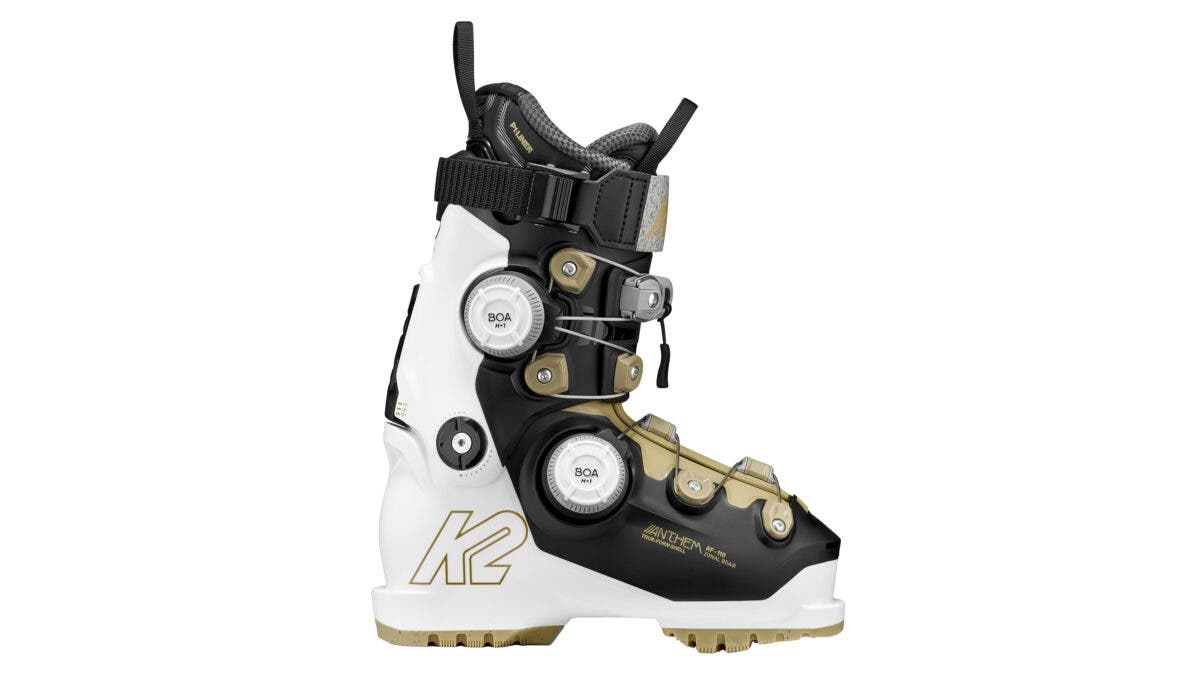
2027 K2 Anthem AF Zonal BOA Women’s Ski Boots
Available flexes: 115, 95 (Anthem AF Zonal BOA)
Last: 100 mm
Sizes: 21.5-26.5
Why “Women’s Boots” Haven’t Really Been Women’s Boots
Understanding why this boot is so groundbreaking requires a bit of unpacking. Most ski boots made by every brand—for both genders—are designed from a mondopoint size of 26.5 (or, in K2’s case, a 27.5), which is the “sample size,” or roughly a men’s size 8.5 and women’s size 9.5. The prototype is tested rigorously and then the brand tweaks it according to testing feedback before producing what ski boot engineers call a “tool,” or the finished boot mold on which all other boot molds will be based.
Then they do what’s called grading, which is scaling the model up and down to create sizes that usually span from a 22.5 to a 30.5. To make a boot “women-specific,” they lower the cuff, soften the flex, sometimes add a calf adjustment, add a heel ramp, and stuff in a plushy liner with a narrower heel pocket.
Thus “women’s boots”—including all previous K2 Anthems—are actually adapted versions of the original men’s that have only been properly tested by people who fit that shell (read: men). This has been the protocol since “women’s ski boots” became available. Until Burrow walked onto the scene with her 23.5 mondopoint foot.
Testing a Boot That Doesn’t Fit You
When she started, Burrow was tasked with testing all the boots as she was engineering them, which she could only do months after the prototype was made because that was when a 24.5 boot became available, which was still a size too big. If you’ve ever skied in boots that are too big for you, you can imagine her sloshing around and balling up her toes. There was no way for her to evaluate any kind of performance until the prototype was scaled, at which point it was past the deadline to make meaningful changes.
“If I wanted to wait to test a 23,” she said, “I’d have to wait a year and a half for it to be made, which would be too late. There was no feedback I could give that would impact the product.”
Aside from the obvious issues that stem from women’s boots originating from men’s boots and being tested only by men, there are other problems that arise in the grading process, Burrow explained. Grading is linear, with all things getting smaller by the same increments. Women’s feet, however, are not just men’s feet in smaller linear increments.
“You can’t shrink the heel more than the forefoot; those two things would shrink the same,” Burrow said. “It’s on an X-Y-Z parameter. Women’s heels are narrower, so as you get into those smaller sizes, you’d want a narrower heel pocket than you would be getting from normal grading.”
And because brands can’t catch these issues in time to correct them, most women—the average women’s size is 24.5, two to three sizes smaller than the prototype—are skiing in boots that may vary significantly from what the manufacturer intended to create. Most men, however—whose average foot size is a 27.5—are skiing in a model that’s only one size off (or is the exact size in K2’s case) the one that received real-world testing and tweaking.
“We figured out our grading parameters [on our existing women’s boots] were wrong,” Burrow said. “But no one noticed because no one was checking the smaller sizes. There was no understanding of how things were scaling.”
Getting K2 to Say Yes to a Real Women’s Boot
Burrow made it her mission to fix this by creating a true women’s boot prototype in a size 23.5 that would be tested by women. She first got buy-in from her immediate team of fellow engineers and the marketing department. “The broader group,” she said, “was more challenging.”
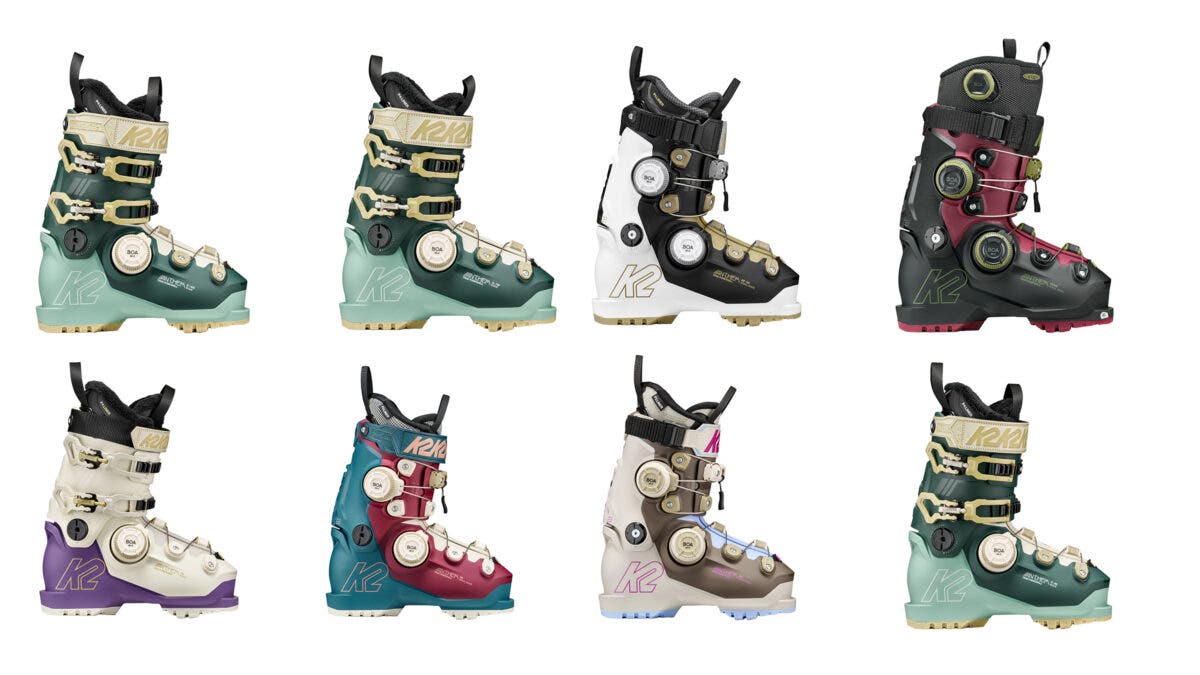
But she pushed, and eventually then-CEO Alex Draper gave her the green light, agreeing to a capital expenditure just shy of 1 million dollars—nearly K2’s entire annual boot budget. “Normally we design one unisex boot” per design cycle, Burrow said. “But we designed both men’s and women’s with both buckles and BOA. It was almost six times as much work as it normally was because we took the time to look at every single aspect of the women’s boot—everything in that boot was unique.”
“Christie drove this and the guys got out of her way,” said Josee Larocque, who replaced Draper in 2024 and is the company’s first female CEO. “When I came on and heard about it, I was in shock that there hadn’t been a true women’s boot already made.”
Building a Women’s Ski Boot From the Ground Up
Burrow overhauled absolutely everything, designing the entire boot from the ground up. Improvements include a cuff height and width designed around—rather than retrofitted to—women’s proportionally larger and lower calf muscles. She also altered the flap shape and cuff to wrap a woman’s leg better, making it cone-shaped instead of a traditional cylinder. She also designed an adjustment mechanism to make the calf even larger for those who need it.
Next, she increased the heel ramp in the boot board and adjusted the shell to match. Because women have a longer thigh relative to overall leg length, they need more ramp angle under their heels to get forward. Bootfitters try to solve this problem by adding a ramp to the existing unisex boot board; but without altering the forward lean in the cuff to match the higher heel angle, the ankle sits higher and loses the stability that comes from the heel being firmly in the shell’s heel pocket. This makes the boot feel as though you’re wearing a stiletto, Burrow said. “Women commonly feel like they’re skiing in the backseat. We increased the forward lean to match the 1-degree increase in heel ramp, giving you the same balanced feel as if the ramp angle were flatter.”
The internal last shape on the new Anthem is also completely unique from the unisex model, with a narrower heel pocket and wider toe box. The industry standard is to make up for the difference in women’s foot shapes with the liner, but that ultimately makes the boot less responsive because women have to push through the extra foam before their power gets transferred to the plastic shell of the boot. “Because we had the ability for the unique tooling, we could put that into the shell directly,” Burrow said.
Fixing the Stance for Women
But perhaps the most important improvement Burrow made is a laterally straighter stance. Because women have relatively wider hips, they have a higher Q angle, which is the angle between the quadriceps muscles and the patellar tendon. This means their femurs angle inward, and their calves go straight down. Men, on the other hand, have a straighter angle from hip to knee, which is why every pair of ski boots has a slight outward lean when you set them on a table. But when women ski in boots that are in the standard position, their knees are forced inward into an A-frame position, and they have a harder time finding their outside edges. Not using both edges equally significantly reduces edge-grip and power.
“Traditional [women’s] ski boots feel super responsive on the medial side, but not the lateral,” Burrow said.
Does It Actually Ski Differently?
So, for women who have been skiing in modified men’s boots forever, will the boot actually feel noticeably different? Early testing says yes. “I believe this boot will speak for itself,” Burrow said. “Every tester we had said they would choose this boot, that it’s so much better than the other products on the market. For the vast majority of women, it will have a better fit out of the box.”
Making Smaller Ski Boot Sizes
As for that fit, Burrow’s modifications didn’t stop at shape and stance. Burrow also did something else that I, who have shoe-display-size feet, could not be more excited about: She built one of the first ever adult resort boots in a size 21.5.
“That was a hill I was going to die on,” she said without blinking.
Getting the new size approved by corporate was more challenging than getting the women’s boot itself, she said. The age-old hardgoods argument goes that the number of 21.5 boots sold will not offset the cost of making that size, which is why small-footed women resort to buying kids’ race boots. But Burrow met her resistance with sharp logic.
The average men’s size is 27.5, she argued to the room full of male reps, which makes that size the bread-and-butter for brands. Then she asked them—all expert skiers who appreciate a race fit—how many of them size down one or even two mondopoint sizes for their own boots. All of them raised their hands. For women who have slightly smaller feet than the average, downsizing for a desired race fit isn’t an option.
Then she read them the results of a survey she sent out to female skiers across the globe. Roughly one in five of them said the improvement they’d like to see in women’s boots was to make them in a smaller size.
Burrow also brought up McKenna Peterson, a K2 athlete whom you’ve seen in Matchstick Productions and Warren Miller Entertainment films, who measures a true 21.5. “She’s skiing these crazy Alaskan faces in a boot that’s too big for her,” Burrow said.
Why It Took So Long
For those of us who assumed that a true women’s boot has existed for decades, many questions remain. Chief among them: why have we had true women-specific skis since Jeanne Thoren originally championed them in the 1990s, and we’re only now getting a true women’s boot?
“We definitely need more women in engineering,” Burrow said. “Women bring such a unique perspective, and for so long we haven’t had the chance to make an impact because our voices weren’t heard in those spaces.” Furthermore, she added, because the industry remains dominated by men, the advocacy for bringing more women in needs to come directly from them.
While she’s thrilled that K2 showed such advocacy in both hiring her and giving her the green light to build the new boot, she hopes it sets a precedent across the board.
“I don’t want this to just be a K2 thing. I want everyone to have a good experience on snow. I hope this will make an impact on all boots from here on out.”
The K2 Anthem boot is a medium-volume all-mountain boot available in flexes 85, 95, 105, 115, and 125 (the Team model), with BOA and buckle options. Some are already available at select retailers online.