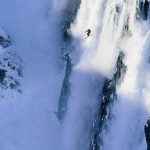
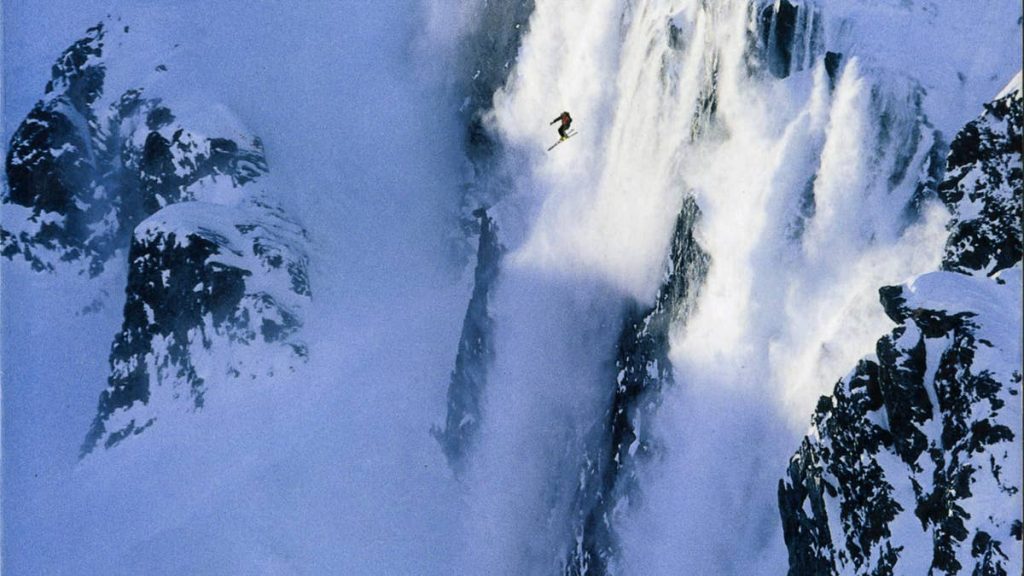
Some people wondered if it was real. A speck—a skier, actually, if you look closely—is framed against a cascading wave of sluff so thick that it could be whitewater. His landing is, well, somewhere? So is his takeoff. But you’d need some imagination to decide where those points in space are against the ominous backdrop of sheer rock and flying snow. Immortalized in a glossy 1999 POWDER cover photo, the 150-foot leap was truly explosive, becoming a piece of media that went far and garnered something like “virality” before the dawn of the social media age.
The star of the shot, Jeff Holden, was an up-and-comer in his early 20s, known for facing enormous cliffs that would turn away less-hardened skiers. Before the photograph, he spent his season competing in—and winning—freeride competitions (he’d end up becoming the overall 1999 Freeskiing World Tour champion) alongside traveling with the gone but dearly missed skier, Shane McConkey, who set him up to film with Matchstick Productions in Europe. Holden was at the top of his game. He went big, and carved artful, novel lines down the flanks of jagged peaks.
But if you have an image of a consummate cliff-hucker and swashbuckling, boundary-pushing professional skier in your head, it may not fit Holden. Best described as soulful, he speaks in a characteristic, laidback voice, often about energies, intention, and spirituality. This orientation could be seen as a contrast with Holden’s rowdier past moves. In another way, though, it makes sense for someone who once tested the limits of what a human could do and survive on skis. Free-falling through space for seconds at a time, after all, involves briefly entering another world beyond ours.
On his way to the POWDER cover, Holden would walk through that door again.
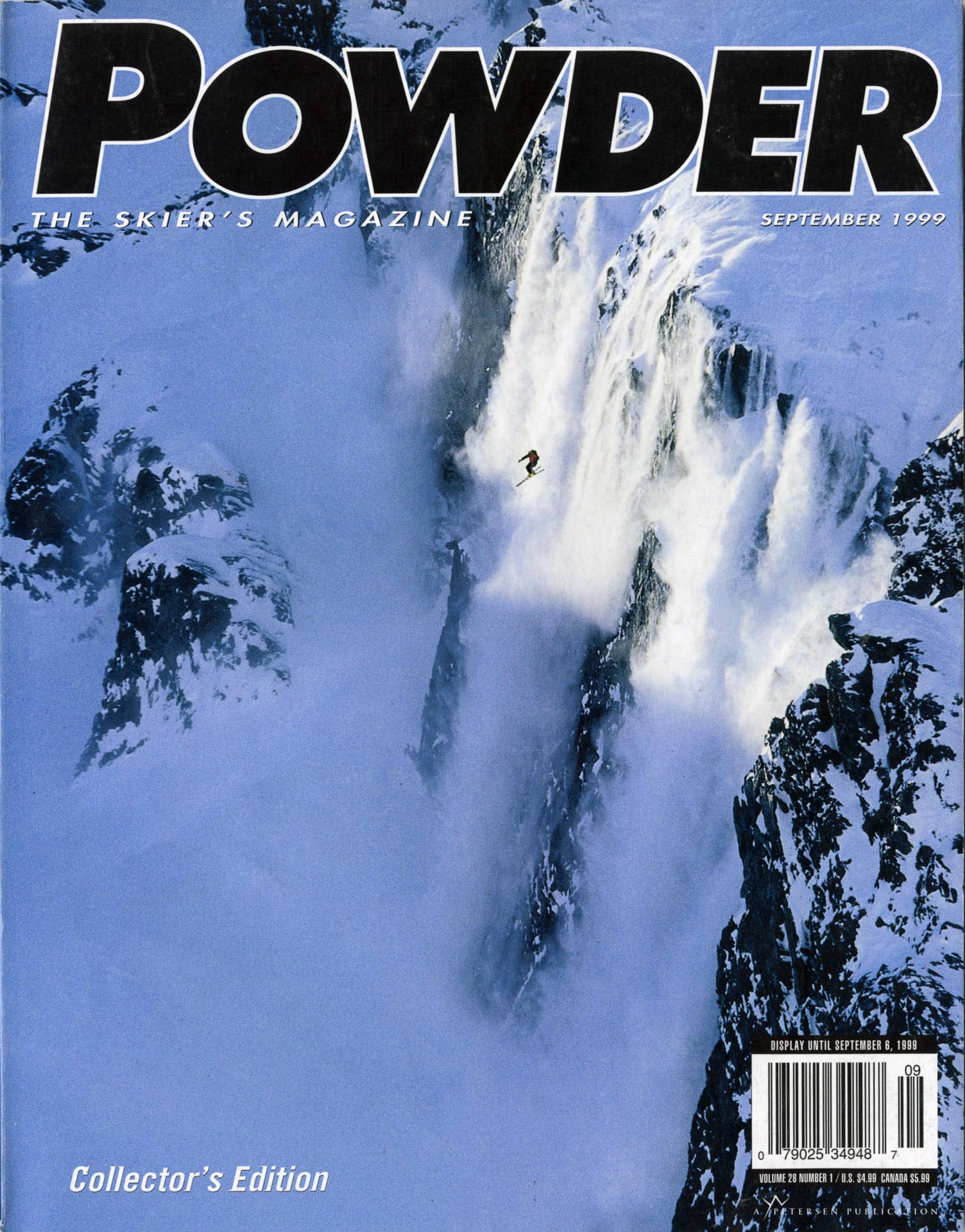
Photo: POWDER Magazine Vol 28 Issue 1 (1999)/Dave Nagel
All Signs Point North
In the spring of 1999, Holden’s ski sponsor, the now-defunct Olin Skis, directed him towards a fledgling heliski operation in Cordova, Alaska, a little place you might recognize called Points North. Founded by pro hockey player-turned-heliski entrepreneur Kevin Quinn, the outfit wasn’t yet established, just starting to welcome its first guests.
Now, it’s one of North America’s best-known places to hitch a helicopter ride and score fresh snow, spanning thousands and thousands of acres in the Chugach Range. But back then, Quinn was just trying to make a name for himself, going into debt and taking out advertisements in as many magazines as he could. The outfit’s peaks and tenure brimmed with untapped, unskied potential.
Other paths began to intersect with Holden’s. Steven Siig, a filmmaker, was traveling north to film the movie Heart and Soul, which Olin had sent Holden to appear in. The man who’d shoot the cover shot, Dave Nagel, was also arriving at Points North. A skier and photographer with a charming, wisecracking bent, Nagel said he’d heard from Quinn that they were going to ski the “good shit.” While he’d since pivoted to focus mainly on his commercial photography outside the mountains—Nagel’s taken some damn good photos of Kobe Bryant—he wasn’t one to turn down an Alaskan romp and do some shooting. His camera came with him everywhere, anyway. A few more rippers, Shanie Matthews and Justin Roach, rounded out the eventual ski crew aboard the helicopter, with guide Jim Barnes and pilot Captain Ron holding it down for Points North.
On a bluebird morning, the group set out, flying into the mountains. Searching for a place for a warm-up lap, they settled on a 2,800-foot ramp, flew up to the top, and dropped in. Siig, who’d only just met Holden, quickly picked up on his skills—a good sign for the footage to come.
“We’re like, ‘Oh, this guy can f—— ski’,” Siig said.
At the bottom, the group convened. While they were waiting for the helicopter, Holden spotted an air adjacent to the run they’d just skied. He liked how the rock looked. It was partway down the line, so he’d make plenty of turns before going airborne. It was also huge, measuring 150 feet. Holden estimated that, at that point, the largest cliff he’d jumped off was 110 or maybe 120 feet. Something like a three-story house hovered between him and the next step. Siig had questions despite Holden’s obvious talent—the newcomer was angling for a big one. But Holden saw no red flags. He boarded the helicopter and headed back up.
Down below, Nagel and Siig got ready to capture the action, taking their positions and noting the light, which beamed perfectly onto the upper reaches of the cliff. Nagel marched a couple hundred yards up the valley for a better angle, while Siig fussed with his camera. His camera’s settings had gotten tweaked somehow, and it was shooting at too high a frame rate, blasting through film. He called Roach, who was at the top, and asked him to speed down and run the backup camera to make sure they didn’t miss the shot.
Above the cliff, Holden meditated. He did this before any of his bigger moves. He used the quietude to hone his focus and set his intentions. Holden said that he thought of those moves as an energetic offering—a piece of art he was sharing with the world—rather than only personal pleasure spikes. That applied whether or not the cameras were rolling.
This time, Holden said he felt thankful for his community and the help he’d gotten from his friends. These notions gave the line and its accompanying cliff its name: Full Support. Today, the ramp remains open to visitors at Points North—and no, in case you were wondering, you don’t have to jump off Holden’s cliff. The drop sits a ways away from the main line, clarified Quinn, calling it a “quintessential heliski run.”
Holden also said he felt no fear. I asked him why, which, he admitted, was a loaded question. Our conversation took a turn. Just a year after the jump at Points North, as his ski career reached a crescendo, Holden lost a dear friend in the mountains, sitting with him as he crossed over. The accident, paired with a cliff diving injury he suffered, shifted Holden’s perspective.
He found a “deeper experience with the sacred,” he said. “You know, life coming, life going.”
This wasn’t fear, necessarily. Holden instead called it a “deeper awareness.” He began to understand—and explore—mental and physical boundaries, embarking on a new path as a freeride judge, event organizer, and trauma therapist. He helped shape the then-nascent North American freeride circuit and worked to implement judging criteria that encouraged clean, controlled skiing (author’s note: I still remember, as a teenager, Holden patiently explaining the venue me and my fellow junior competitors would ski the next day). He now serves as the IFSA’s technical director chair.
At the end of our detour, Holden offered another reflection on being afraid. Or finding a moment when the fear vanishes.
“I think it’s a delicate balance of being in tune with the air, in tune with the fire, in tune with the water, in tune with the earth, in tune with the ethers,” said Holden. “When there’s that alignment … there can be a certain amount of overriding the energies of fear.”
Override, he did. Nagel watched as Holden made perfect S-turns above the cliff band. Siig trained his camera. Holden leaped.
“Everything was kind of like slowed down, a little bit transcendental,” said Holden. “Spacious in the air.”
You Could Say It Went Viral
If Holden stepped outside reality for a glorious few seconds, the world around him was still moving. Faster and faster. In 2000, Outside reported that, as he soared through space, Holden eventually reached speeds just above 60 miles per hour. To break the impact, Holden laid out his body and rotated to his butt and back, producing a sizable bombhole in the snow. It was a long trip. After taking a few shots of the upper line, Nagel fired through the rest of his 36-frame roll of film before Holden touched down. Siig’s camera, meanwhile, ran out of film the moment Holden took off. But Roach still caught the action.
“We’re all freaking out,” said Siig. “We were beside ourselves because this was a groundbreaking moment.”
When Holden clambered out of the snow and reattached the ski that blew off his foot, Nagel had him play a little game. The photographer liked to ask skiers he’d just shot to stick out their hand once they’d completed their chosen cliff or line. It was a rough case study in how adrenaline affects the human body. Most of the hands Nagel saw shook. In his remembering, Holden’s didn’t.
“He skied down to me, and he looked at me, and he said, ‘Where do you want to go next?’ Just like it was a Tuesday at Whistler,” Nagel recalled. “I’d never seen anything like it, man, he had literally nerves of steel.”
Nagel sent the photo out to several outlets, including POWDER, but gave Holden a say on where it ended up. Nagel joked that he’d really love to take credit for the shot, but said the picture was 90% Holden. He said he’d just been lucky to be standing there and record it.
Amid what Nagel described as a bidding war for the photo, they settled on POWDER, which later ran it as the September 1999 cover. It became one of the magazine’s most memorable openers, a true all-timer. But the shot went even further, later ending up in Outside and even German Playboy.
“I guess you would have said back in the day it went viral,” Nagel said.
That came with doubters. Holden’s jump was, in fact, unbelievable enough that some assumed it had been faked. These days, you can call images your eyes don’t trust AI. In the 1990s, they worried about Photoshop instead. But it happened. Nagel’s shimmering negatives proved it. So did the footage Roach and Siig captured.
And, perhaps most importantly—beyond the hoopla and the cover—the shared memory of a beautiful time spent at a new heliskiing frontier, where the party was just getting started.
They “kind of celebrated,” Holden said, “and then we got in the heli, and went and skied another first descent.”