Updated May 13, 2026 11:54AM
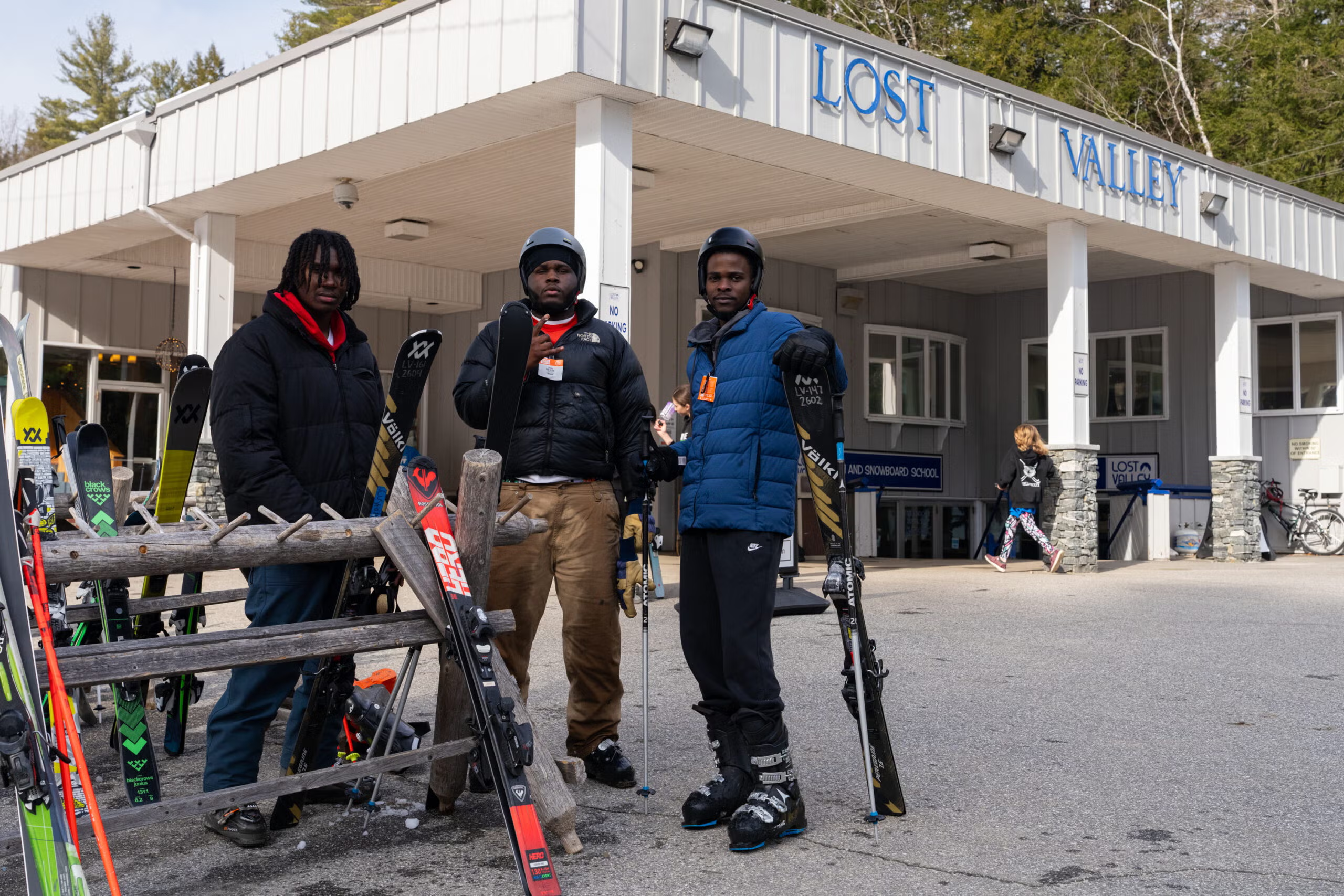
On a chilly evening last December, at Lost Valley Ski Area in Central Maine, a 22-year-old Afrobeats emcee who calls himself Loyal Prince stood at a lift station waiting for his friends to show up. As the first in his generation of young asylum seekers from Southwestern Africa to arrive in his community, Loyal Prince was used to playing guide. Since his arrival in the U.S. in the summer of 2019, he’d been tasked with the unofficial job of showing his peers how to navigate the complex journey of American life. Now, with a few winters under his belt—and a solid snowplow to show for it—his most recent chapter of this journey was taking place on skis.
“Life the bar!” Loyal Prince shouted downhill. “Lift the bar!”
The intel—as it often did—made its way from one boy to the next, with little time for comprehension or second-guessing. Cristiano, Ibra, Alfonso, Miguel, one by one, were ejected onto the landing in a tangle of bodies, skis, and poles. Like many of their American experiences, the boys had received no special training or instruction on how to exit a chairlift. Loyal Prince, filming the wreckage on his iPhone while heckling each of them individually, knew from his own experience that learning how to ski was the kind of problem that the boys had to solve on their own.
After all, there were bigger problems looming on the horizon. In recent weeks, the boys had gotten word that Immigration and Customs Enforcement agents had been showing up in nearby towns. No one seemed to know exactly why, or who might be next, but the arrests had been ongoing since the summer.
Though the boys had all arrived in the United States at different times and under different immigration statuses, their journeys to Maine had mostly followed the same path. As part of what the media had dubbed a “migrant caravan,” they’d left behind home countries of Angola, Congo, and Burundi to travel some 4,000 miles across the mountains and jungles of Latin America, pit-stopping at various border checkpoints, immigration processing centers, and emergency shelters, to eventually settle in temporary housing in their adopted hometown of Brunswick, some 20 miles south of Lost Valley Ski Area.
To clear the wreckage on the snow, a lift attendant, stifling a good-natured smile, shut the lift down as the boys struggled to their feet. “Ay, ay, ay,” Loyal Prince said, shaking his head. “You all’s embarrassing me!”
And yet, as the sun set over a stand of white pines, his response seemed less a matter of embarrassment than disbelief. To most skiers, arriving at the 480-foot summit of Lost Valley would inspire little in the way of awe. (The 22-trail resort is known locally as a beginner’s paradise.) But for these boys, the memories of their journeys never far behind them, their arrival at this moment was nothing short of a miracle. Not even in the four languages that swirled around in Loyal Prince’s head could he find the words to describe such a feeling. Perhaps, he thought, if he was able to afford enough studio time, he might capture the feeling in song.
Making First Tracks
To be fair, Loyal Prince’s introduction to skiing had been equally messy. As a boy growing up in the suburbs of Angola’s capital, Luanda, a port city on the west coast of Southern Africa, his exposure to the sport had been limited to watching videos of white people flying down mountains on little boards with sticks in their hands. Esqui, it was called, in his native Portuguese. The way they floated through the world reminded him of the hero in the poorly dubbed and pirated versions of “Fantastic Four: Rise of the Silver Surfer” that he used to watch with his boyhood friends. Back then, living amidst civil unrest, violent crime, and vicious poverty, skiing just seemed like one of the many exotic experiences that lived in a Western fantasy world that he would never know.
Then, about six months after he’d arrived in the U.S. in 2019, Loyal Prince experienced his first snowstorm. The snow that fell that night was not the snow-globe variety he’d seen in American Christmas movies. It was icy and strange, and fell from the sky as little pebbles that bounced off the street and turned the pavement white. As he watched the world transform, some instinct told Loyal Prince to take a few running steps and then, to let himself go. Aha!, he thought, gliding to a stop. He did it again, then turned around to see the parallel marks he’d left behind. First tracks.
That first winter in Maine was equal parts cold and confusing. First, there was the question of proper gear, provided mostly in trash bags of donated goods from local families and relief organizations. The vintage fur-lined housecoats and down parkas, the ill-fitting gloves and mittens, the clunky, style-less boots—it all seemed like so much trouble just to go outside and still freeze. Then there was the question of winter sports. Some kids put on strange shoes with metal blades to glide across ice; others drove gas-powered snow-cars on trails through the woods. Then there were the kids who disappeared for weekends at a time, to nonsensically named locations—a loaf of sugar? A horse saddle on your back?—only to return to school on Monday with windburned faces and funny-looking tans, posting happy selfies riding chairs that carried them through the sky.
“Hell nah,” Loyal Prince thought when considering whether skiing would ever be in his future. “Skiing for me, it was just not, like, even in my brain. I was like, ‘I’m not ready for that thing yet. I’m not at that level. I’m not American.’” And so, he filed the sport into that ever-expanding category of baffling American experiences that would never be available to him. He and his friends had a name for such things: White People Shit.
But over the next few years, as Loyal Prince graduated from high school, got his first jobs—bagging groceries, washing dishes—then enrolled at Central Maine Community College, he began to understand something crucial about White People Shit: Sometimes, it could be very helpful to know how to do it.
So, in the winter of 2022, Loyal Prince—guided by some friends on his college soccer team—found himself at Lost Valley. (As a fully enrolled student at CMCC, lift tickets were included with tuition.) Before his first run, he was offered only a single piece of advice: to position his skis in the shape of a slice of pizza.
Pizza, Loyal Prince thought. Pizza.
Of all the American foods that he’d been offered over the years, pizza was easily his most despised. Upon arriving in the U.S., pizza was what he’d been served at emergency shelters; pizza was what American friends’ parents offered him when he’d first been invited to their houses to play video games. In the school cafeteria, pizza was the only food he’d recognized as familiar, so he had mostly survived on it.
Pizza! Pizza! Pizza! Why did Americans eat so much pizza? And now, here it was again, between his skis. How he longed for some fufu pondu.
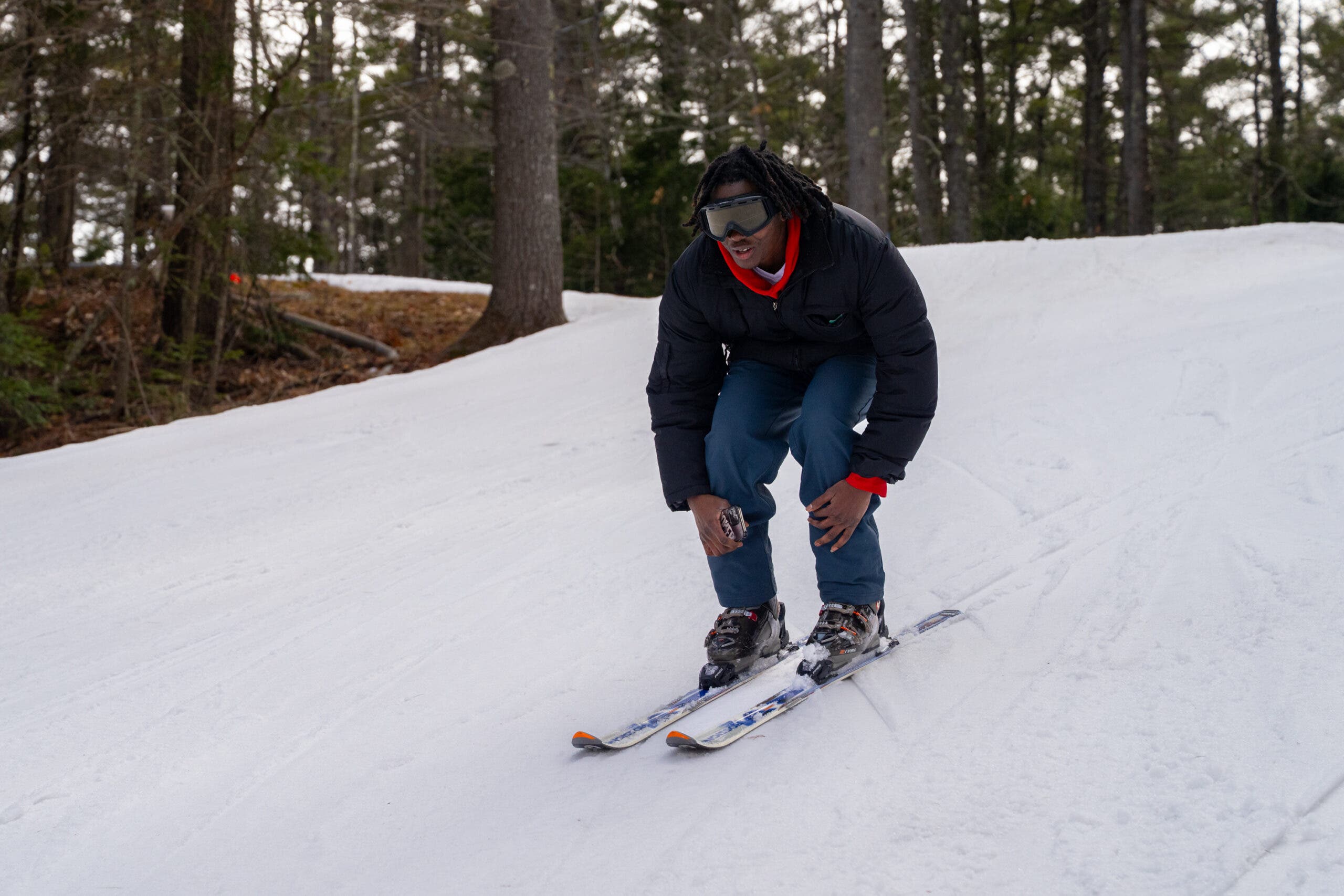
“I just keep falling and falling and falling,” Loyal Prince recalls of his first night at Lost Valley. Initially, all the falling was funny. Then the novelty wore off. The sight of so many little kids racing past him, the sound of teenagers heckling him from above, began to fill Loyal Prince with familiar, creeping despair. He saw the way people in his community kept falling and falling and falling whenever the speed of American life left them behind. Learning English, finding low-wage employment to send money back home, securing a driver’s license and housing, all while navigating the legal labyrinth of the asylum-seeking process. Falling was a way of life. And yet, if there was one thing he had learned about himself in the years since his arrival in Maine, it was that he—always lifted by some inner music—had a unique capacity to keep getting up. “Bro,” Loyal Prince told himself, fighting his way back to his feet for what felt like the hundredth time. “I gotta learn how to do this.”
And so, Loyal Prince kept going back to Lost Valley. To ease the price of rentals, he hustled a used setup: a pair of 2005 Rossignol women’s Saphir 2 in 160cm, with some Tecnica Rival boots of the same vintage. Good enough. Soon, by watching other skiers, his pizza gradually morphed into French fries. There were days when Loyal Prince loved being the only African on the mountain—it made him feel special, like he’d broken through some invisible wall. Other days, he says, it made him feel lonely to be the only Black person on the mountain. “People look at you, especially when you’re not that good at it, and they just know you’re not from here,” he says. “You kind of feel like damn bro, why they look at me weird?” But often, he noticed that the gazes of other skiers expressed something more like admiration—”Like damn bro, look at him, he’s really trying.”
As Loyal Prince became more comfortable on skis, the anxiety of being watched began to fade, and in its place came another feeling: freedom. Doing laps at Lost Valley, often under the glowing lights of the 3 to 9 p.m. Friday night sessions, the sensation was akin to what he feels when he is making music. “When I’m in the studio,” Loyal Prince says, “I feel like I can do whatever I want. And when I’m skiing, when I’m going down the mountain, I feel the same thing. Like I’m free. Like I’m flying.”
Soon, he started posting Lost Valley reels on his Instagram account. Typically, the 15,000 followers he’d amassed through his 30-track music catalog were accustomed to watching clips of Loyal Prince in studio sessions, rapping at parties, and promoting his most recent tracks. What were these other videos? His peers started to wonder if they could give skiing a try, too. And so, as was often the case, it fell on Loyal Prince to lead them up the mountain.
Lost … and Found
Earlier that afternoon, on the 40-minute drive from Brunswick to Lost Valley, the chatter in the car had little to do with the particulars of skiing. Instead, after years of silence, the boys used the time driving down rural backroads, past farms and fields, to reflect on the memories of their journeys to the United States.
“You got no food, you don’t know where you going, you just walking,” was how Cristiano, now 20 years old, remembers it. He wasn’t sure how long it had taken. Four months? Five? He was barely 15 at the time. How could he be sure?
To anchor their memories, sometimes the boys compared notes. They all had seen dead bodies along the way. They’d all watched people drown in rushing rivers, witnessed parents separated from their children. They’d carried babies on their backs, traversed mountain ranges, and negotiated life-and-death deals with bandits. Along the way, they’d met people from around the world—Cuba, Venezuela, other African nations—communicating in a patois of Spanish, French, and English. Sometimes, the memories of their journey are hard to separate from the nightmares that still haunt them. Cristiano recalled being chased by a lion in Panama. “Panama don’t have lions!” the other boys said, laughing. But Cristiano was sure of it—the lion was real. Then came the question of whether, under dire circumstances, they would ever take such a trip again. “Naw, hell no,” Alfonso said. “Not unless you paid me.” For the next few minutes, the boys tossed around numbers. Four million dollars seemed to be the going rate.
When the boys had first arrived in Maine, they found that people “always want to know the stories,” Loyal Prince says. “But why would you talk about something that just makes people cry? But now, we’re healed a little bit. We can flash back. Nowadays, it’s fun to talk about it. It’s like: I did that shit. I made it. Some people might think we cap’n, but it makes me feel alive.”
These days, what haunted the boys more than the past was the present. The arrival of ICE in Maine was a chapter of their journey that none of them had ever expected. They’d come so far, endured so much, only to find that, now, time seemed to be moving backward. As they drove through downtown Lewiston—a city about five miles from Lost Valley, with a sizable immigrant population—they passed a line of African women carrying groceries on top of their wrapped heads. “Look at them OGs,” Loyal Prince said, shaking his head. The boys agreed. Now was not the time to be standing out.
The mood lightened as the city streets turned into the wooded rural roads of Auburn. To build some stoke, Loyal Prince played songs from his most recent album, “Longe de Casa,” or, in English, “Long Way from Home.” The boys knew the choruses by heart. Filled with giddy energy, they speculated about the best strategies for surviving their impending first run down the ski hill.
“Go with the flow,” Alfonso said. “You see your friend do something that works, just do the same!”
“Stay up, stay still,” Ibra said. “If you keep falling, and everyone is laughing at you, don’t give up!”
When the Lost Valley sign came into view, some of the giddiness turned to caution.
“Lost Valley,” said Ibra. “That mean we gonna get lost?”
Loyal Prince assured Ibra that the mountain had trails.
But as Loyal Prince pulled into the parking lot, Ibra still couldn’t get his head around it. “So we gonna climb this mountain?”
Loyal Prince pointed out the chair lift, the people floating across the sky on a cable. “You ride it up,” he said.
Ibra nodded. “Bet.”
As for Alfonso, he wanted to know why there was so much snow on the mountain but not on the ground.
“They make the snow,” Loyal Prince explained.
“How?” Alfonso asked.
“Out of that river,” Loyal Prince said, pointing to a stream running alongside the road.
Alfonso gave up. “I’m too black for this shit.”
As the boys stood in line for rentals, they observed a group of young women walking through the lodge. In researching “skiing” on TikTok, Ibra had come upon several videos referencing the term “ski bunnies.” Somehow, the algorithms had led him from “ski bunny” to the similar-sounding, but more loaded, term: “snow bunny.” Ski bunny and snow bunny—was this the same thing? Ibra wanted to know.
Loyal Prince laughed, then explained the difference. A ski bunny was a nice girl you met at Lost Valley; the other term—maybe that was one you kept to yourself.
“Ah, Papa,” Ibra said.
Always Another Hill to Climb
“Pizza!” Loyal Prince called out from the first pitch of a beginner trail called Squirrel Run. “Make a pizza!”
To even the most entry-level skiers, the 100 yards of slushy corn that stood before the boys wouldn’t pose much of a challenge. (You can cruise all of Squirrel Run in about 10 turns.) But that night, the drop-in was pretty raw: Alfonso got a good start, then tumbled into a patch of dirt. Cristiano dropped into a full tuck—“out my way!”—but soon crashed into the tree line. Miguel got his tips going in the right direction, but lost control and collided with Cristiano.
Ibra, as if in slow motion, floated about 10 feet into the woods, trapped inside a glade of tree branches. His iPhone recording, Loyal Prince couldn’t resist the opportunity to document his friends’ beginner ski status for his followers. “Tell us what you doing in the forest, Ibra? How you get so lost?”
“It’s Voodoo,” Ibra said, wrestling with a bush. “Voodoo!”
A few laps later, the boys were still stuck on their second lap down Squirrel Run. Loyal Prince paused to take stock of his crew. There was no denying it: the night was not going very well. Ibra’s gloves were soaked through, his hands so cold that he couldn’t grip his ski poles. Alfonso, dressed in a double layer of down jackets, was drenched in a full sweat, on the verge of overheating. Alfonso, often the most buoyant of the group, looked forlorn. Cristiano had stepped out of his bindings and was headed back to the lodge with a ski in each hand.
“I give up,” he said.
Loyal Prince looked up at the mountain. “You walk all the way through the jungle just to give up?”
Cristiano shrugged. “I spent all my energy coming to America,” he said.
The other boys, equally dejected, followed behind him.
“My boys gave up,” Loyal Prince mumbled to himself.
Alone on the chairlift, Loyal Prince checked the videos he’d posted. They were already getting views. A friend he’d traveled with through the Darién Gap—a treacherous 60-mile stretch of jungle, mountains, and swamps along the Colombia–Panama border—had posted one in return. His family had resettled in Canada, and now he was skiing somewhere north of Montreal, flying downhill before wiping out. Six years ago, somewhere in Nicaragua, the boy’s father had defended Loyal Prince and his family from an armed assailant who’d tried to rob them of what little money they had. Now, separated by a border neither of them could cross, Loyal Prince dreamed of the day when he might have a green card. Then maybe he could go visit his old friend in Canada. Maybe they could go skiing. You had to have dreams.
And yet, on nights like tonight, Loyal Prince felt like no matter how many times you made it down one mountain, there was always another one to climb. “Skiing is the only time when I don’t think about my other bullshit,” he said. “When I leave everything behind. When I can just live in the moment.” He looked behind him, where the other boys, having returned their rental gear, were waiting to leave.
“Once I leave here,” Loyal Prince said, “I know all the bullshit is just gonna come back.”
The Euphoria of Speed
Loyal Prince wasn’t wrong. Late this January, a surge of ICE agents—in undisclosed numbers—arrived in Maine, prompting roughly 200 arrests in about two weeks of heightened operations. While the streets erupted in protest, the general response in Loyal Prince’s community was to “lay low.” Adults stayed home from work; children and teenagers stayed home from school; Loyal Prince and his friends stopped skiing. Just as he was beginning to get his ski legs, the very sense of freedom that he found flying down his favorite runs at Lost Valley all but vanished. He knew what it felt like to be in lockdown—the year after he’d arrived in the US, he’d found himself living under the restrictions of the pandemic, but this was different. This time, the fear wasn’t abstract or collective. It was personal, unpredictable—who might be stopped, who might disappear, and how quickly everything could change.
Day after day of lying low, isolated amidst the grind of winter, the music that usually lived inside Loyal Prince grew quiet.
By early March, though, the surge in ICE activity across Maine had mostly subsided. One upside of the winter of 2026 was that it turned out to be one of the snowiest in over a decade. All that snowfall meant an extended spring ski season. Loyal Prince convinced the boys to get back to Lost Valley. Sure, there were still stories of ICE detainments taking place within their community—a friend had been pulled off the street and now waits in a facility two states away—but one could not live in fear.
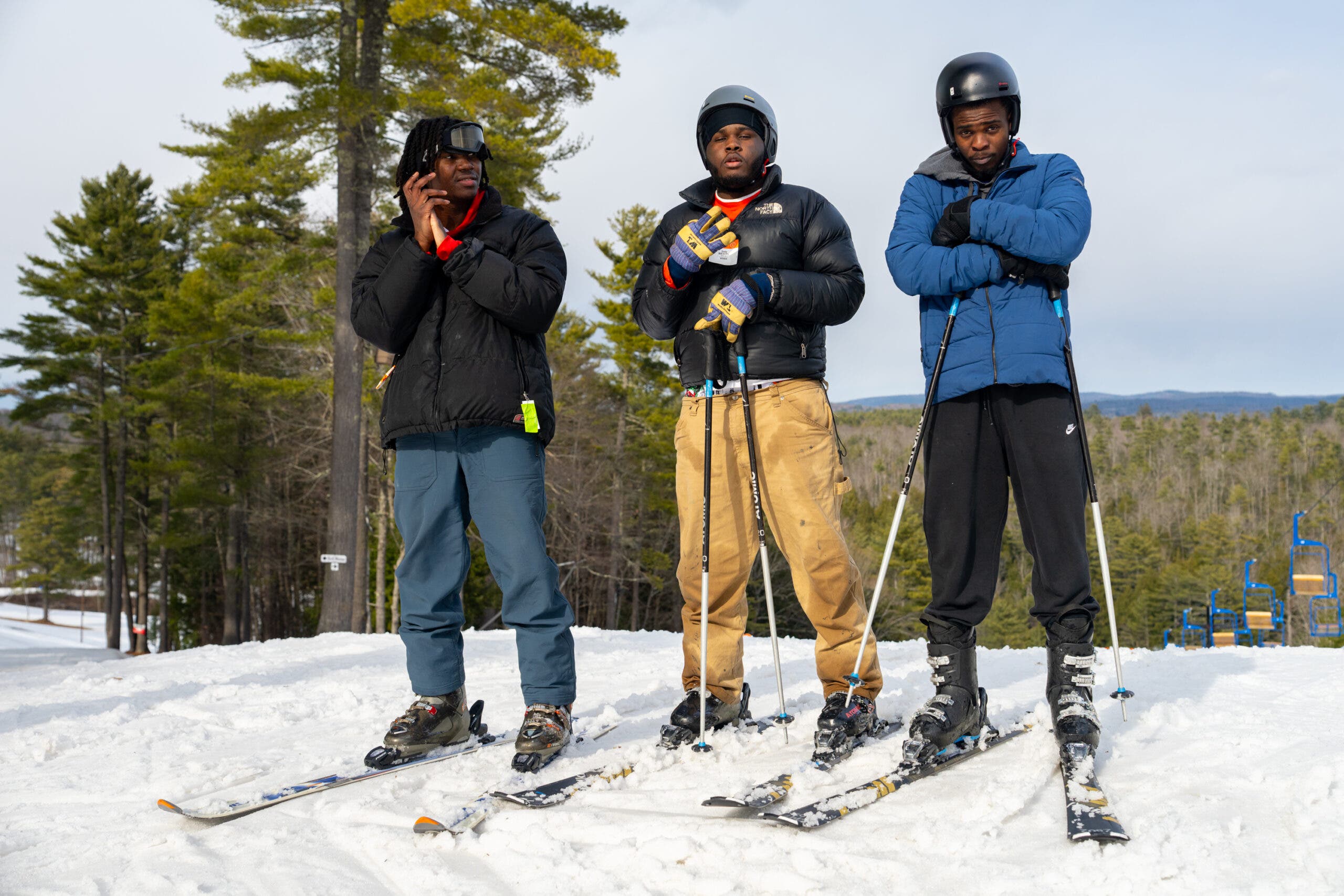
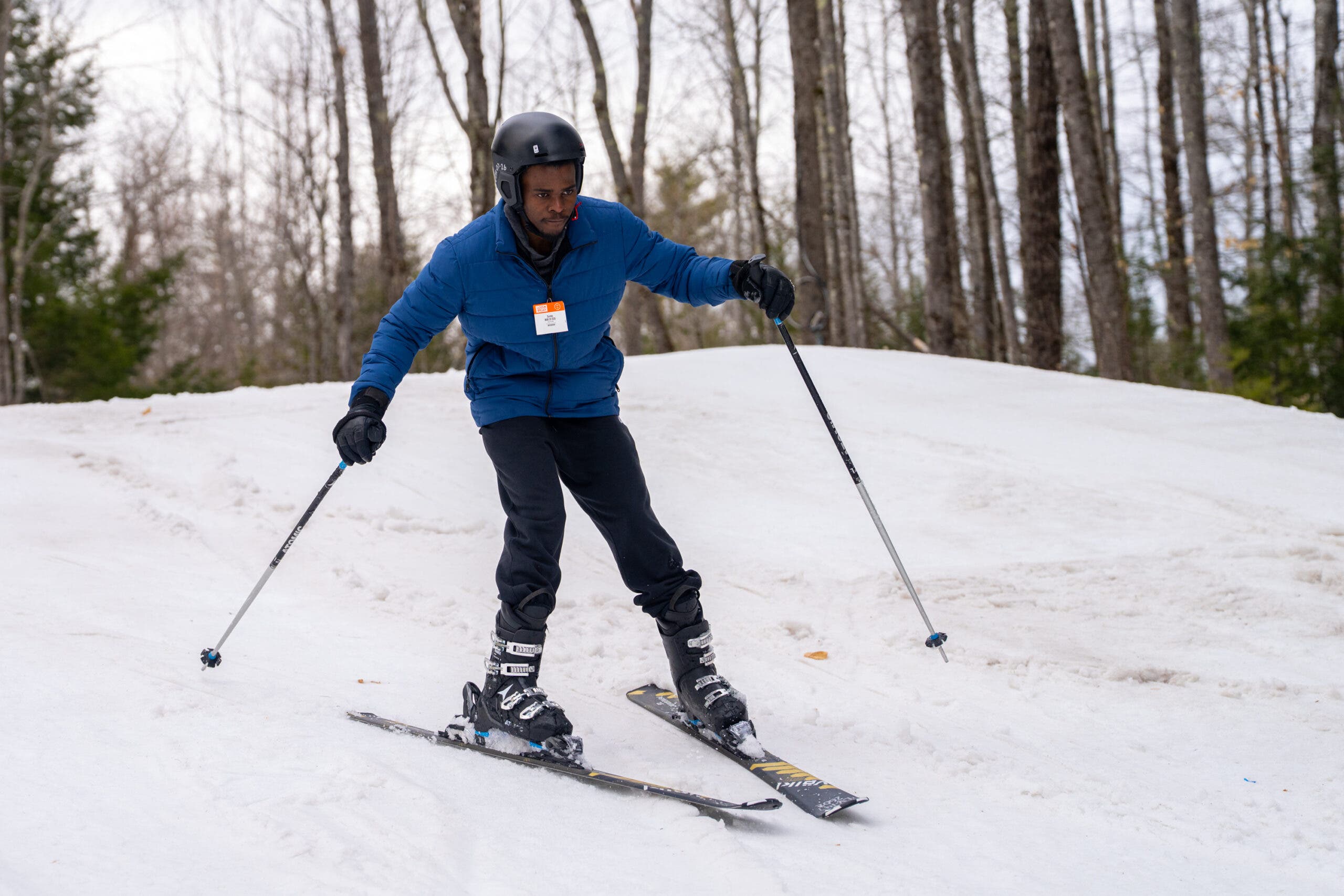
The first day out, the boys made the biggest gains. They learned how to ski over their toes a bit, how to drive their inside edge on a gentle turn. And with a few days of temps above freezing, the snow had turned soft and corny and more forgiving. Loyal Prince had discarded the pizza instruction, opting instead for a more heroic motif. “Like this,” Loyal Prince said, butt down, legs in a near split. “Just like Jean-Claude Van Damme!” That was more like it. Back in Africa, the boys had all seen more than enough JCVD movies to get the idea. One after another, they dropped into splits, hit top speed, and disappeared into the darkness.
“Mao!” Loyal Prince yelled—Portuguese for badass. “Maaaooo!”
“I think I can learn to do this,” Ibra said, after several more laps on Squirrel Run. Typically timid, the euphoria of speed was beginning to have its way with him. “Green card! Green card!” the boys shouted as Ibra cut loose. Over the last several runs, the phrase had become the migrant skier’s equivalent of a US-citizenship full send.
Alfonso had invented a method of moving his skis from pizza to French fry, pizza to French fry, in a kind of flowy dance. Miguel was bursting with confidence. He started to celebrate every fall-less lap by dancing at the bottom of the lift, accompanied by an acapella version of Melo’s “Tweaker.” “I might bend, I might swerve, whoa-oh-oh!” Miguel sang, flexing. Loyal Prince observed their improvement with a kind of paternal satisfaction. To keep himself busy while the boys worked on their turns, Loyal Prince had taken to dancing while skiing and working out the chorus for new songs while flying downhill.
The Last Dance
The boys skied right up until the final day of the season in early April. On the afternoon of closing day, the Lost Valley parking lot was packed with locals. In front of the lodge, people danced to country music and classic rock, drinks in their hands, adorned in goofy Hawaiian shirts and leis. Rental skis were on sale for $25 bucks. A pond skimming competition was underway.
The boys walked through the carnival atmosphere with a mild sense of suspicion and hesitancy. It was still a little strange to be out in public so freely, but they had learned to just put their heads down and keep moving. At one point, a big black dually with two American flags streaming out of the bed revved past them in a way that seemed overly intentional, but the boys didn’t take the gesture too seriously. Lifts were closing soon and they had a score to settle with the mountain.
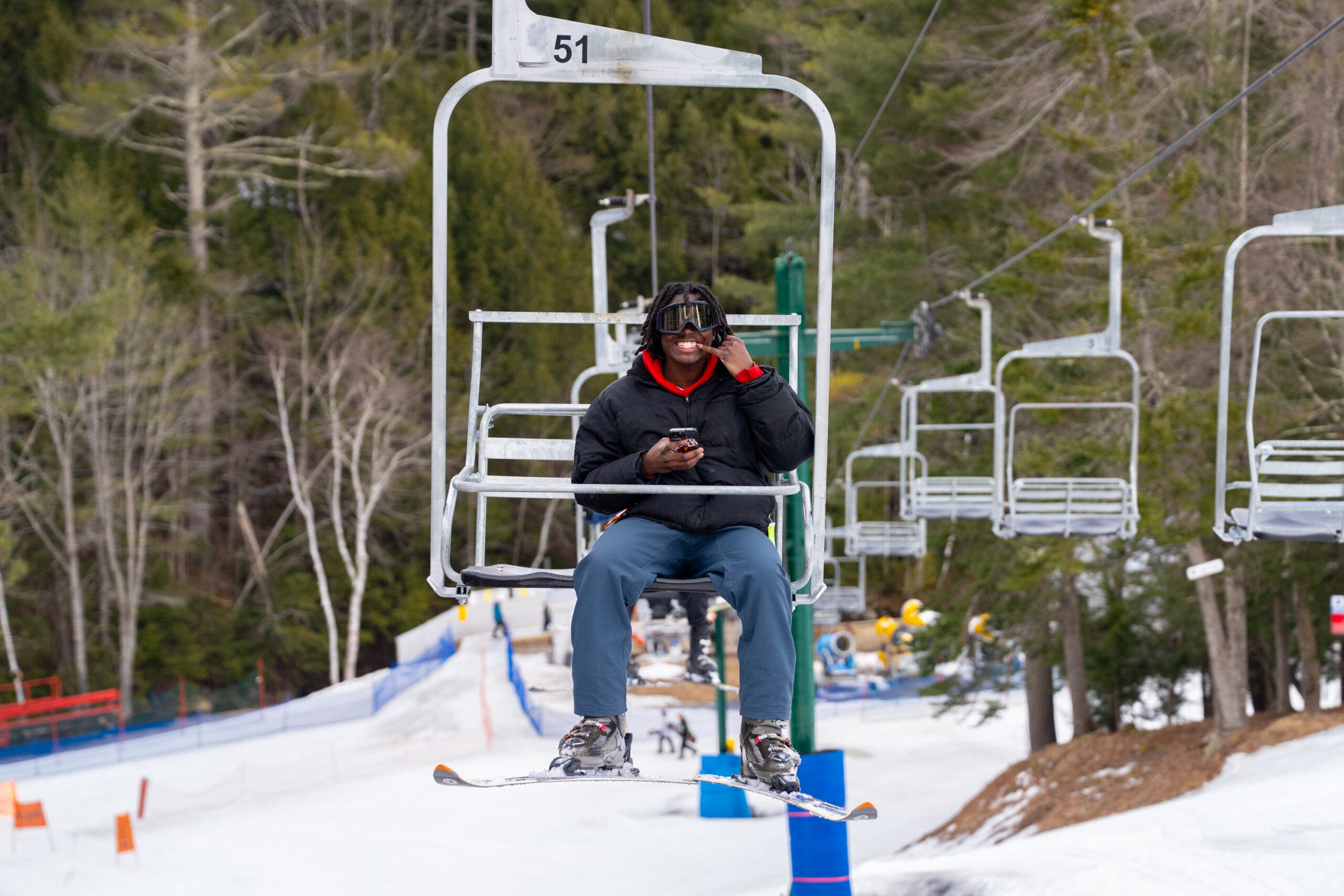
At the summit—by now, getting off the chairlift was second nature—Loyal Prince made sure they all gathered for a final photo op. “Last dance, you feel me?” he shouted to the boys. He told them that their final run of the season would take them down Pine Grove and then to a trail called Big Buck, Lost Valley’s veritable headwall. There was no going back.
“Yes, sir!” Loyal Prince shouted, cutting loose at full speed. The boys, left to themselves, had no choice but to follow behind him. “Fuck it!” Loyal Prince shouted, gaining speed. “I’m American now!” He dropped into a half-tuck. The snow beneath him was like wet cement, but 20-year-old skis made short work of plowing through it. Faster and faster, he skied as if propelling himself into a new world, where falling and falling and falling held no consequences. As he cleared the steepest pitch, all that speed collided with the soggy flats. Loyal Prince tumbled forward dramatically. It almost looked intentional. Flopping onto his back, he looked up at the sunny bluebird sky. “Never give up!” he shouted, hands in double peace signs. “You gotta suffer! You gotta get hurt in order to learn! It’s part of the journey!”
As he watched the other boys navigate Big Buck, Loyal Prince couldn’t stop laughing. One by one, they picked their lines, a few wobbly turns at a time. Behind them, ski patrol was literally closing the mountain down. The last run of the season, Loyal Prince couldn’t believe it, belonged to him and his boys. As he stepped out of his skis—Click!—the sound grabbed his attention. He paused, put his boot back in his binding. Clack! He repeated the sequence twice more—Click! Clack! Click! Clack!—moving his head along with the rhythm. “Aha,” Loyal Prince said out loud. “I can make a beat out of that.”