As ski resorts struggle to convert first-timers into lifelong participants, Snöbahn believes the answer lies indoors.
Published June 2, 2026 12:13PM
Around 80 percent of first-time skiers never return to the slopes. Learning to ski takes time and money. It takes hours spent outside in the cold in rigid plastic boots cranked down tight and heavy, sharp-edged planks that pull your body down the slippery hill whether you’re ready or not.
After becoming part of the 20 percent who survived the first day and tried again—and becoming one of the rare few to ski at a collegiate level—Sadler Merrill found himself back in the ski trenches, this time as a dad to three kids.
In 2014, he came to the conclusion with a friend that teaching your kids to ski at the resort was a waste of time and money. They wondered: What if you didn’t have to drive to the mountains? What if you didn’t have to dress for the cold, brace for nasty falls, or lug a bunch of gear? What if you didn’t have to shell out hundreds for a ski lesson? And, most importantly, what if you could learn faster and easier another way?
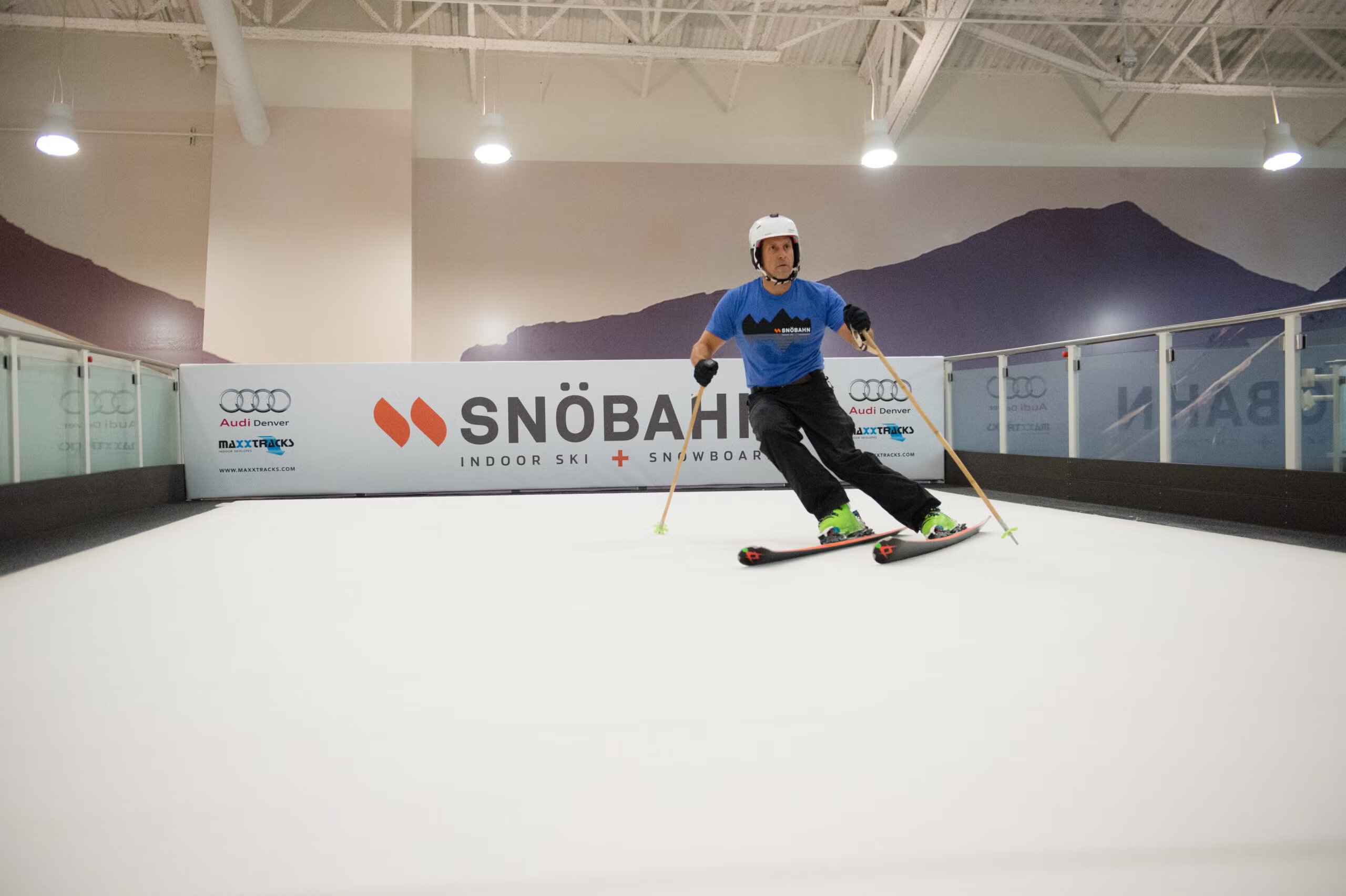
That was the impetus behind Snöbahn, an action sports center that Merrill opened in a Denver, Colorado suburb in 2016, followed by a second location just north of the city. Both locations have revolving nylon carpets that emulate the ski slopes with adjustable speed and pitch.
The carpets are inside, where it’s always a comfortable room temperature and lessons are just 30 minutes rather than the typical half- or full-day options you’ll find on the mountain.
“We say in 30 minutes we can get as much done as a half-day lesson at the resort,” says Merrill.
Skiers get on the carpet with their instructor and face a full-length mirror at the bottom of the slope where they can see their form and compare it to their instructor’s. Feedback and adjustments are immediate, and new skiers can go from a bunny-hill pitch to a steep blue with the press of a button. The instructor carries a remote that can stop the carpet in an instant, making falls a non-issue.
“It’s a very efficient way to learn. At full speed, full pitch, you can ski 21,000 vertical an hour. That’s equivalent to a full day at a resort,” says Merrill. “The slopes allow for high-quality, high-volume training and then really short feedback loops so you’re making changes in real time and that accelerates progression.”
Complete newbies use Snöbahn as a ski season test run. You can figure out how to put on your boots, click into your skis, and carry your gear while getting your first ski lesson out of the way. Some spend the summer at Snöbahn so they’re ready for winter. Others spend weeknights there to prepare for a weekend ski trip, and some swing by Snöbahn en route to the mountains to wake up their ski legs.
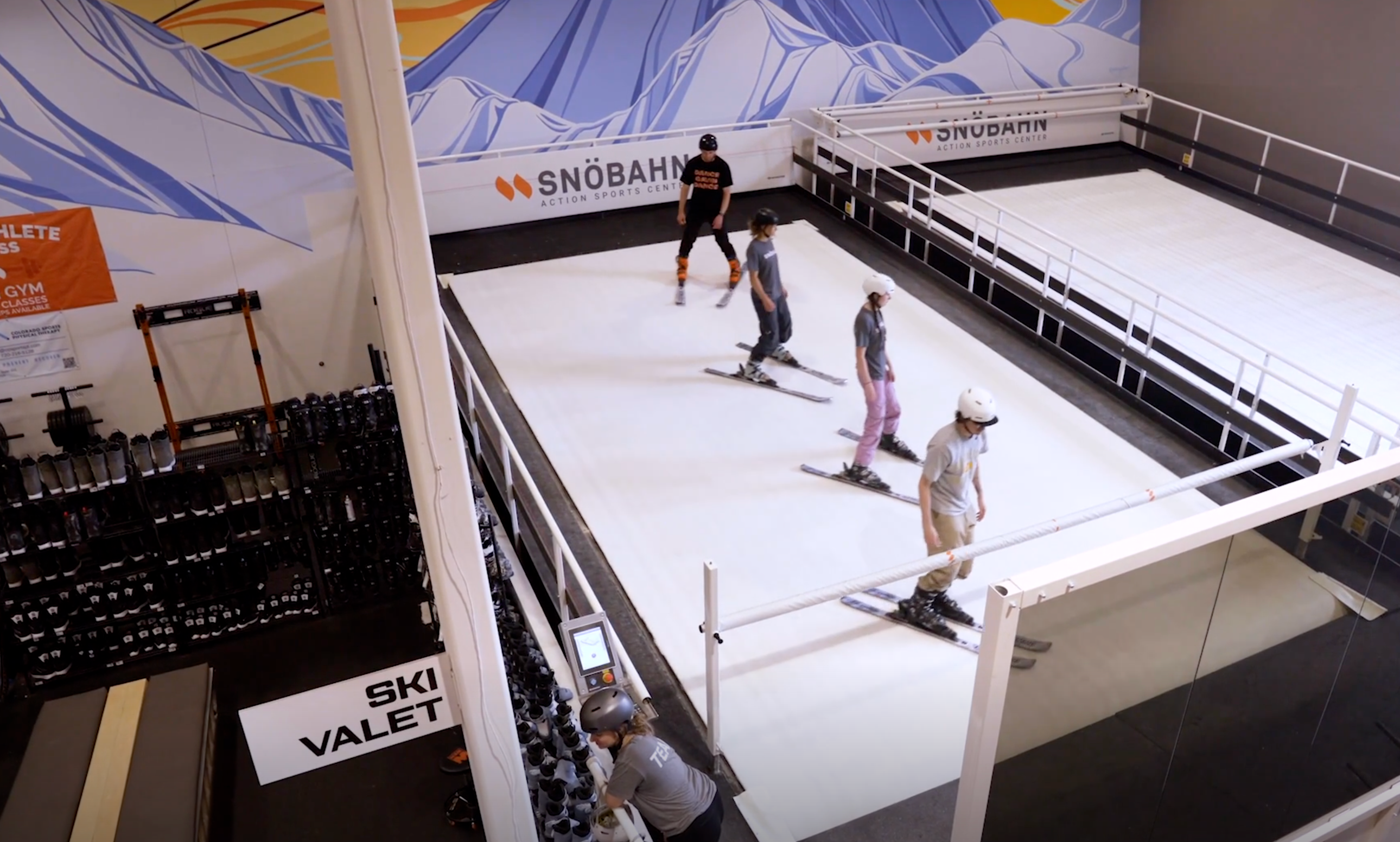
The temperature inside Snöbahn is always a balmy 70 degrees and the facility is open daily, year-round, regardless of snow totals. Skis, boots, helmet, and poles are included in the cost, and you can ski in anything you can move in.
Speaking of cost, you’ll spend a fraction learning to ski at Snobahn compared to taking a lesson at a resort. Semi-privates start at $40 and private lessons begin at $80. For comparison’s sake, a group lesson at a destination resort is in the ballpark of $300, with private lessons upwards of $1,000 a day, not including tip.
In addition to newbies and skiers looking to hone their skills before a ski trip, ski teams and pros come to Snöbahn to perfect their technique.
“The secret of it is that this one-inch turf that we wet about once every hour is less forgiving than snow; it’s sort of a truth serum,” says Merrill. “It manifests all your weaknesses and so you really have to refine your technique.” And, you can refine it quickly and easily. “Here, you can ski up to 45 turns a minute and something like 2,700 turns an hour.”
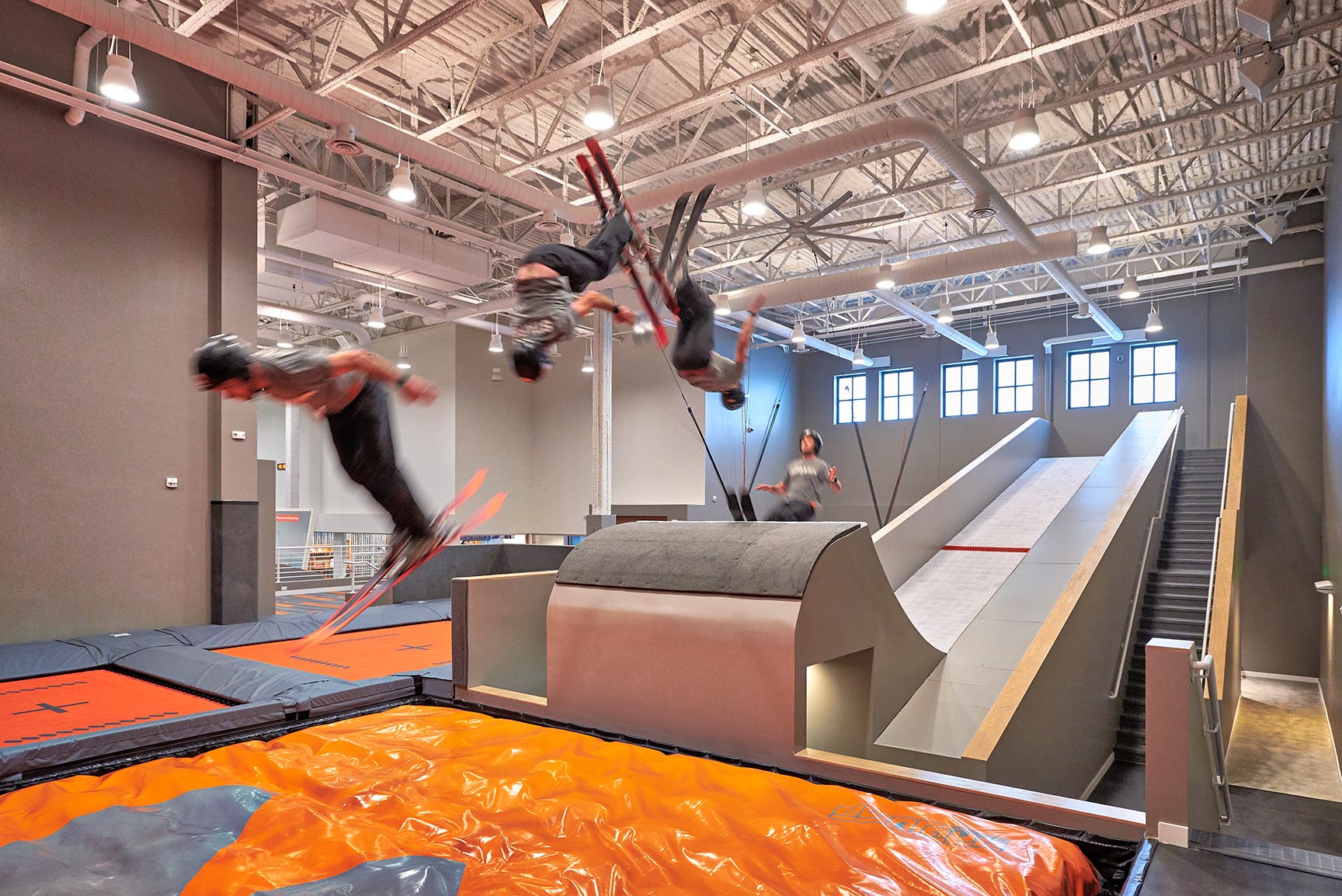
In addition to the indoor ski slopes, Snöbahn has trampolines and airbags where you can test out ski tricks, along with skateboarding and BMX parks.
Perhaps the biggest stat under Snöbahn’s belt is that 98 percent of their customers say they’ll be lifelong skiers. For Merrill, that number matters more than anything else. If the first day on skis no longer has to mean frozen hands, burning through your paycheck, and hours spent falling, maybe more people will stick with it long enough to understand why that 20 percent showed up a second day—and a third, and a fourth.