Published May 26, 2026 10:48AM
“That’s not even skiing anymore,” I grumpily announced, dismissing the news that Christina Lustenberger had just skied the first descent of Mount Robson’s south face, with partner Gee Pierrel, in February of 2025. “It’s just downhill alpinism.”
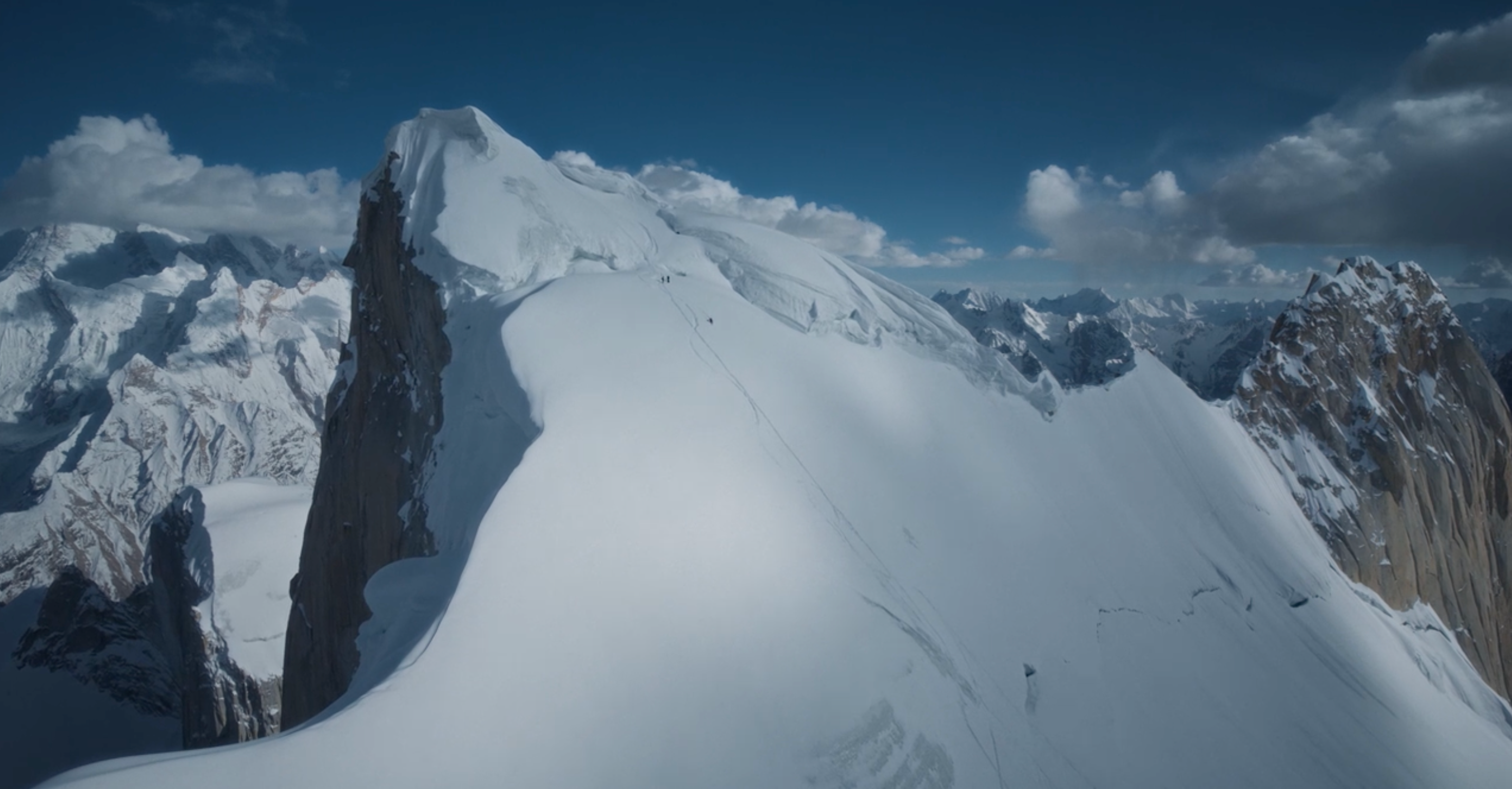
Lusti, as she’s known colloquially and amongst friends, had been on a tear. In the preceding years, she’d ticked off the remote couloirs of Baffin Island, Mount Sir Sandford’s south couloir in B.C., Pakistan’s Great Trango Tower, a whole whack of gnar on New Zealand’s Mount Cook, and now Robson’s unimaginable Great Couloir: a 9,842-foot ribbon of rotten snow spray painted to the side of a cheesegrater nearly 10 times the height of the Empire State Building.
In the apex of her career, she’s set her sights squarely on descending mixed-climbing routes that often don’t even look skiable, and she has succeeded. In between rappels … it took seven on Robson. To make turns in these places requires a rack of climbing gear, unshakable focus, and flawless execution. Her practice is closer to free solo-ing than it is freeriding. And, not that long ago, I thought that was the coolest thing in the world. So my sharp disapproval surprised even me when I heard it out loud.
I was once transfixed by the accomplishments of those who use ropes and ice tools to slide down snow in places most people couldn’t even stand. They were like real-life comic book superheroes to me. I tried my best to surround myself with them and to emulate them. I spent a winter in La Grave, France, literally learning the ropes, and brought that craft home to B.C., where I pushed as deep as I could into the Columbia Mountains and Canadian Rockies.
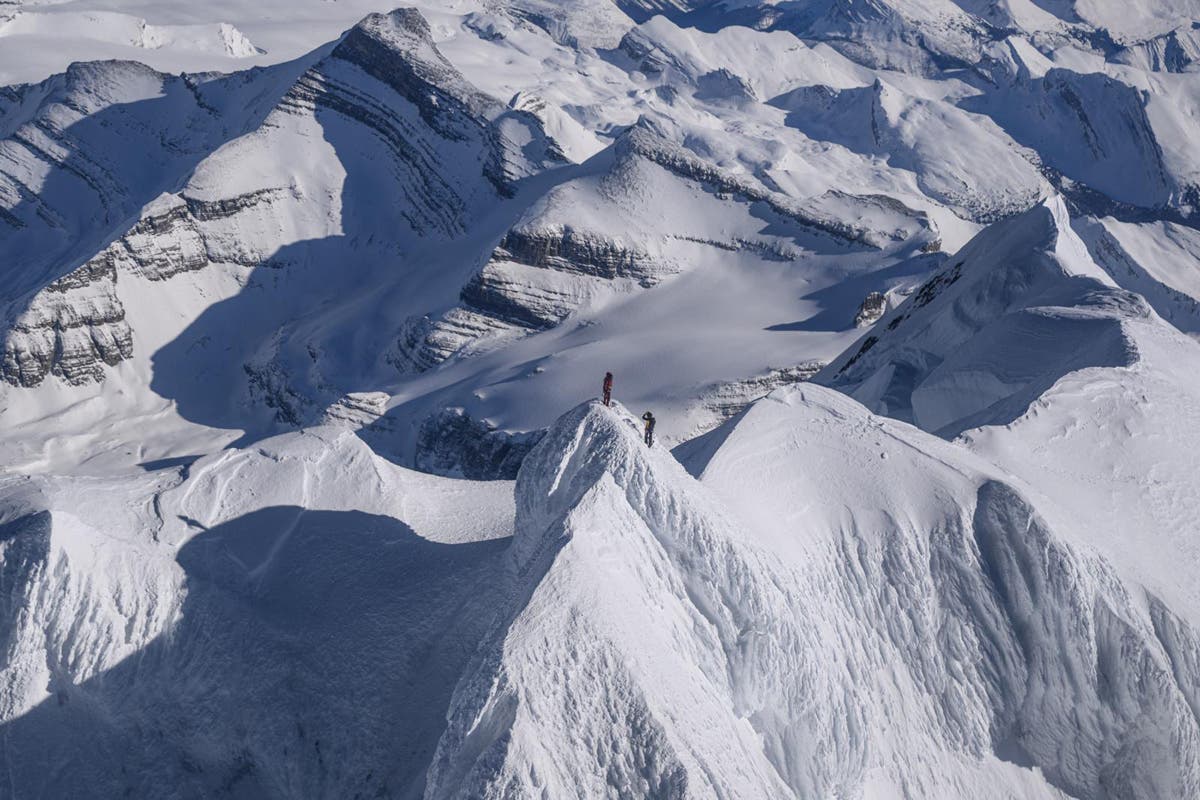
I traded ski lifts for skins, cliff hucks for crampons, and joined the ski-mountaineering bandwagon of the time. I linked up with the strongest senders in my home ranges, and fixated on life-or-death lines. It felt like a calling—my generation hadn’t been to war, and mountain survivalism was some kind of twisted version of that for me. But it was also a thrill. Until it wasn’t anymore.
Over time, people I skied with started to die: Andreas Fransson, Hervé Maneint—only a week after I made turns with him in Chamonix—and then my friend Dave Treadway. As time passed, some of the most experienced people close to me got mangled in avalanches and big falls. All throughout, I built up my own catalog of close calls.
By the time I turned 40, with my strength fading and reality hitting harder, I found other skiing outlets. Nowadays, I don’t have the stomach for ski mountaineering. But what’s surprising is that I don’t seem to have the stomach for others doing it, either. As my own risk tolerance has atrophied, so has my vision.
The Great Couloir was a generational achievement, done in superb alpine style, during Arctic conditions. This was the full realization of a skier I myself excitedly called the future of ski mountaineering in a Powder magazine profile I wrote about her almost a decade ago. And here I was, now wringing my hands. How did I become the clichéd old man shaking his fist at these crazy kids?
The fact is, very few of us will ever be a Lusti, but most of us, if we don’t check ourselves, will become critical of anything we wouldn’t ourselves do—blind to the widening bandwidth of our own judgments as we creep up in age.
It’s common for physical risk to lose its appeal over time, we know that. But it’s a chicken-and-egg question as to how and why. Does risk lose its appeal because you’re inherently weaker, or do you become inherently weaker by exposing yourself to risk less as “normal” life piles on—responsibility, family, etc.? Who’s leading the dance here, our minds or our bodies, and why does that so often make us lose sight of what’s possible for others who are still in their prime? A 2023 study in the journal Cognitive Science put it this way:
“Research suggests that moral evaluations change during adulthood. … We propose that, because older adults perceive accidents as more likely than younger adults do, they condemn the agents and their actions more and even infer that the agents’ omission to exercise due care is intentional.”
In other words, heuristic traps go both ways: The less you see a given result, the less you expect it—and the more you see it, the more you expect it. All the while, the probability never changed, it’s only your amount of baggage that did.
As the trauma of adulthood and inevitability of loss permeates our later years, our calcified brains can’t always keep perspective on the fact that boldness doesn’t only come from ignorance.
People need purpose, and while climbing mountains has been called useless, for many, it fulfills something deep inside—which is as legit a calling as any. Those drawn to ski in places that require surgical precision when the consequence of a mistake or bad luck is certain death are not, as a rule, clueless; you can have a full and sober view of risk and still make an informed decision to take it.
And those of us planted safely in the peanut gallery should be on guard not to not overly project our own damage onto others.
The statistical reality of repeated exposure to objective hazard is real, of course. But it’s not new, it has always framed the limits of what’s possible, and humans have always been explorers. Taking big chances has propelled our species to new heights all throughout our history. Risk-taking is not a call to death, it’s a call to a very specific kind of life. Was the moon landing worth it? Was the high-dive record worth it? Was the first backflip worth it?
Every single person alive and skiing today is the benefactor of those vanguards who put it on the line to help map the contours of these mortal coils we’re bound by. For my part, I will try to remember that and celebrate all the wonders our species is capable of, even as time wears on me, my hair grays, and my friends cause my heart to skip a beat.