Published August 20, 2026 02:37PM
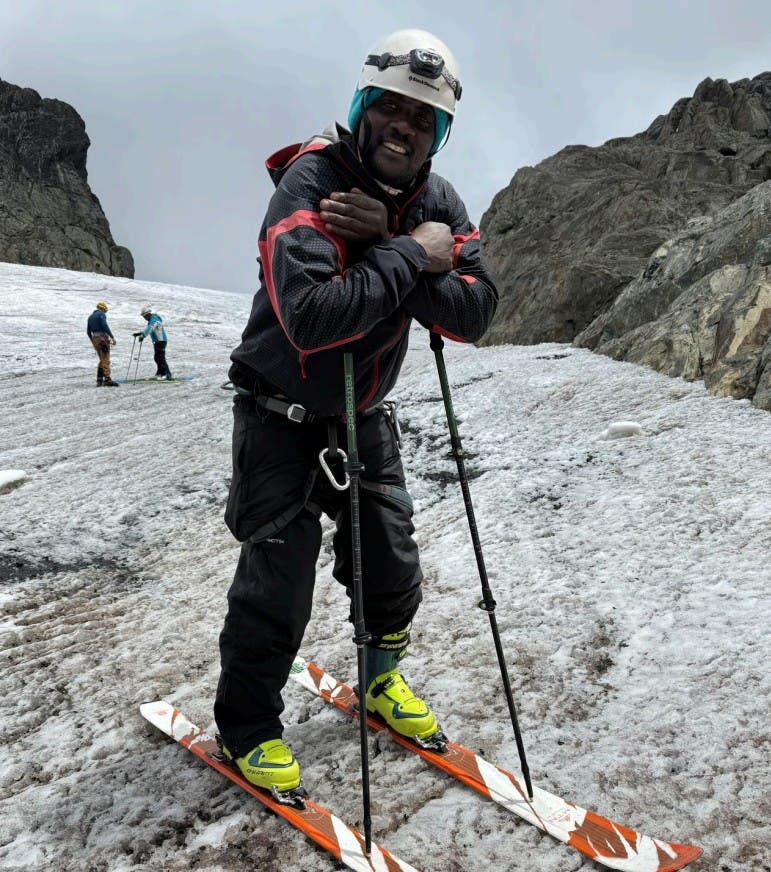
After a five-day bushwack through endemic cloud forests and heather, Edison Kule’s neon green Dynafits click into place. Turn by turn, he descends down one of Africa’s last intact equatorial glaciers, straddled between the DRC’s vast green jungles and Uganda. Below, the towering Rwenzori peaks shimmer faintly in the morning haze.
But at the heart of what seems like yet another rogue quest for the remote and untouched lies a ski expedition that might save the communities below from disappearing forever in the face of climate change. That expedition is organized by Ski Club Uganda (SCU), once an obscure relic of British mountaineering culture that recently saw a major revival as young adventurers looked for the craziest powder they could find, but also wanted to leave communities better than they found them.
Partnering with Kule and Brian Kilabama of Rwenzori Trekking Services (RTS), as well as scientists from Penn State and Makerere University, the club has attracted international skiers, students, and volunteers and turned a local tree nursery into a major movement. What’s more, it has supported the first generation of Ugandan skiers like Kule—now skiing the mountains he grew up leading tours on.
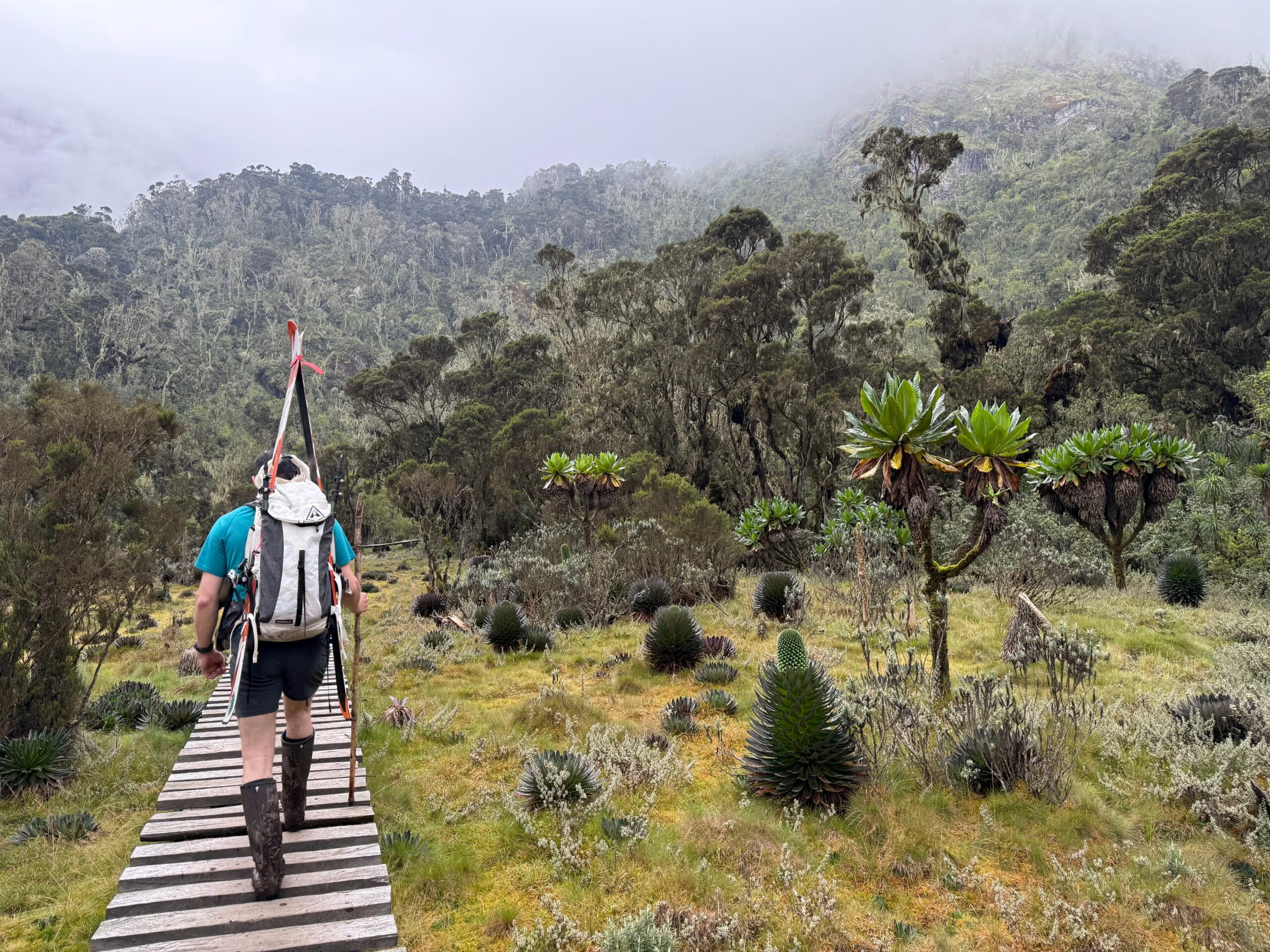
Only a few weeks prior, after a layover in Brussels, a pitstop in Kigali, and a 10-hour car ride from Kampala, we finally unloaded our skis in Kilembe, Uganda. It was my first time taking malarials, and my back had all but succumbed to the roads’ infamous “African massage” our driver had laughingly warned us about. Yes, I know what you are thinking. Why in the world would anyone fly across the world to ski in a country literally located right on the equator? That’s probably what the lowland gorillas were asking themselves as well.
We were on a mission: to plant 1,500 trees in Kilembe’s riverbanks before skiing the Rwenzori glaciers. But three months post ACL operation, I would not join my team above to ski, but rather stay in Kilembe, helping to cook for our almost 50 Ugandan, American, and European volunteers.
It’s late afternoon, and bright yellow curry bubbles in the background as Kule, chief mountain guide with Rwenzori Trekking Services, passes a roll of chapati. Katie Perry plays in the kitchen.
“I happen to be the first Ugandan preparing to ski this mountain tomorrow, and I’m looking forward to it,” Kule grins, a serene smile forming above his well-trimmed moustache. “It’s a shame that I lost count, but I remember [summiting] 100 times … after 100 times, I lost count.”
The Local Hero
Kule, a member of the indigenous Bakonzo people, grew up in a neighboring village. Since he began to guide as a young man 15 years ago, that mountain has changed dramatically. But so have the communities below.
In its mining heydays, the rumble of excavators and clinking of machinery announced the break of dawn in Kilembe, sending the village’s fathers and sons into some of the world’s richest copper and cobalt reserves. Nowadays, the breezy mountain town offers a respite from the dusty and hot avenues of nearby Kasese, nestled below terraced foothills along the banks of the rushing Nyamwamba. Uniformed children rush from morning mass to school amid wafts of smoldering yam. Since the decline of Kilembe Mines, life has slowed down in its namesake town.
“I like being at home helping my wife with the farm. I like farming,” says Kule. “I also like listening to gospel music.” Unlike Kule, most Bakonzos livelihoods depend on subsistence farming, such as banana and yam. Some grow coffee that they sell downstream. “I feel proud, I think I am one of the lucky Bakonzo around this mountain.”
With the help of porters, cooks, and assisting guides, Kule leads eight-day expeditions to 5,109-meter (16,762-foot) Margherita Peak, a permanently ice-capped rock face jutting out from Mt. Stanley’s (aka Mt. Ngalimea) north face. The hike involves passing through clouded montane jungles, bamboo groves, rushing waterfalls, and martian-looking plateaus dotted with the local flora, including lobellia, sinesio, and misty heather. At the top, trekkers are rewarded with the breathtaking Stanley and Margherita glaciers, two matte grey tongues of ice clinging to black volcanic rock, which, during the rainy season, get covered in fresh powder.
Skiing on the Equator?
In the wet season, blizzards drape the glaciers in glistening powder overnight. At the break of dawn, humidity and temperature are just right for that victory lap. The upper Margherita Glacier is steep, and you’re sending hop turns through fresh snow. However, it’s just a few hundred meters. By midday, the equatorial sun turns the descent into a breathless trudge through white cement. But then there is also the much flatter Stanley Glacier below, which can add extra vertical if you have skins. It’s all high altitude, above 4,500 meters (14,500 feet), but at the equator the atmosphere is most dense, so you have fewer altitude problems.
Anyone who skis the Rwenzori glaciers becomes a lifelong member of Ski Club Uganda. “I would encourage my fellow Ugandans to try it,” says Kule. “Come out. Then the rest will be fine.”
Not surprisingly, the search for untracked powder has remained a rare endeavor in tropical Uganda. Less than 30 people in recorded history have skied the Rwenzoris, starting with British mountaineers in the 1950s. Nowadays, muzungus (Swahili for foreigners) visit from many countries, hiring a guide to see the park’s unique ecosystems and summit its peaks.
Fast-Disappearing Glaciers
Unfortunately, these ice caps, like those on Mount Kilimanjaro, are destined to melt in a few years, maybe even by 2030. “We have to adapt to other things because it’s only the glacier that will go,” Kule says. “The mountain will still be there. So, we can still do something like rock climbing.”
And while climate change may alter the nature of mountaineering in the Rwenzoris, a much greater question is how a snowless mountain will redefine Bakonzo mountain identity.
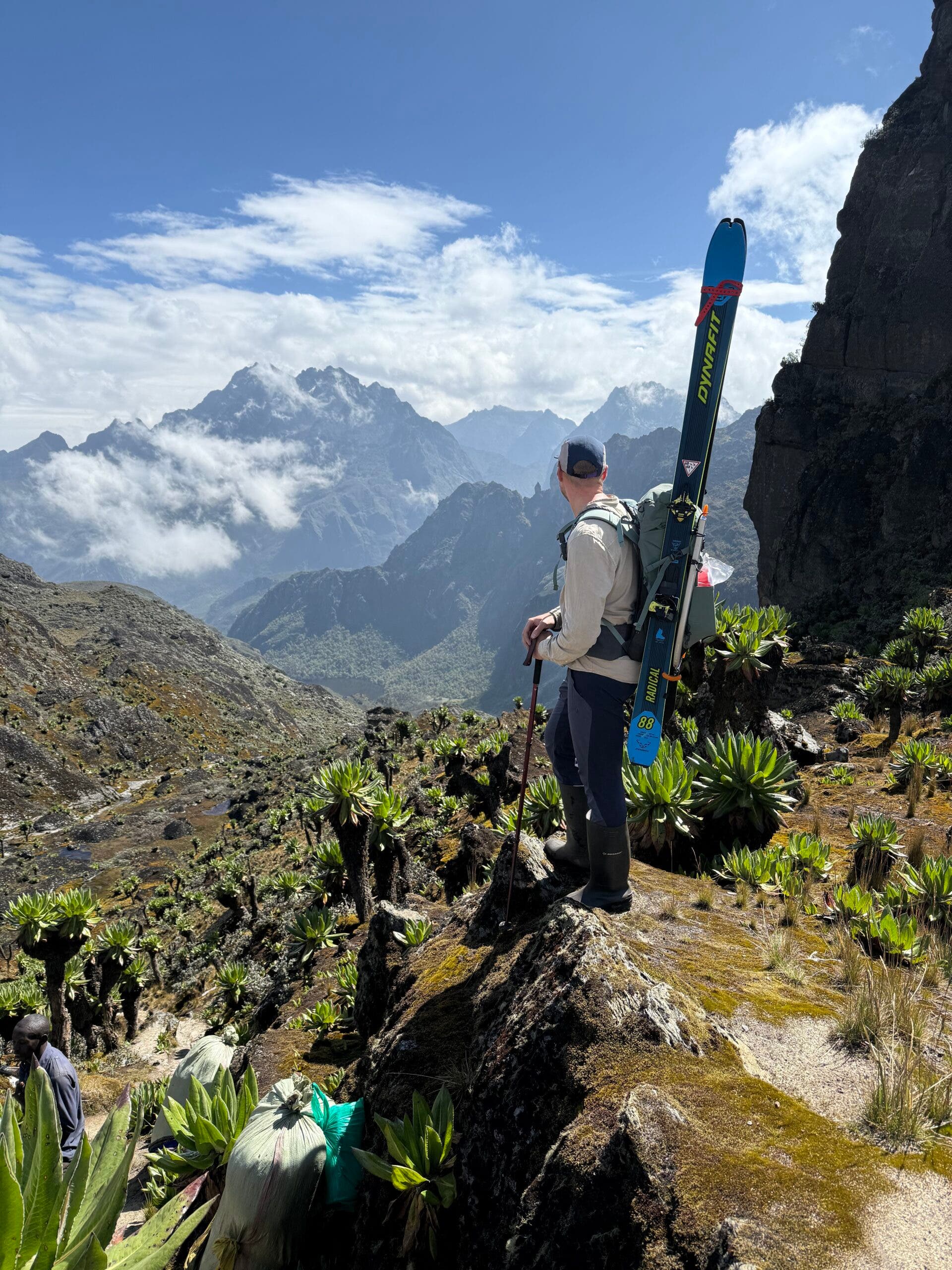
“To the life of the Bakonzo it is a very big threat, because the Bakonzo have all their beliefs on this mountain. Apart from calling themselves Bakonzo, they are abanya rwenzori [people from the land of snow].” Kule pauses, his calm eyes scanning the shadows of our smokey base camp kitchen, a few idle carabiners dangling from his cargo pants.
“For us the Bakonzo, we don’t call this mountain Rwenzori, we call it the mountain of snow,” Kule explains. “Meaning when the snow is off their mountain, the Bakonzo will have nothing to say about their mountain.”
And they are not alone. This year’s El Niño heat is only a reminder of the roughly thousand glaciers that disappear annually, many in indigenous communities.
Fear the River
Aside from their identity, the Bakonzo face a far greater existential threat. Squinting into the distance, I rub a ripe coffee bean between my index fingers, watching the pulpy kernels roll into my palm. Kule rises from his chair, pointing out the riverbank in the distance.
Come November, when the Bakonzo rain Gods arrive, the languid Nyamwamba River awakens from a deep summer slumber, while the incessant patter of raindrops announces the start of monsoon season. But not all monsoons are created equal.
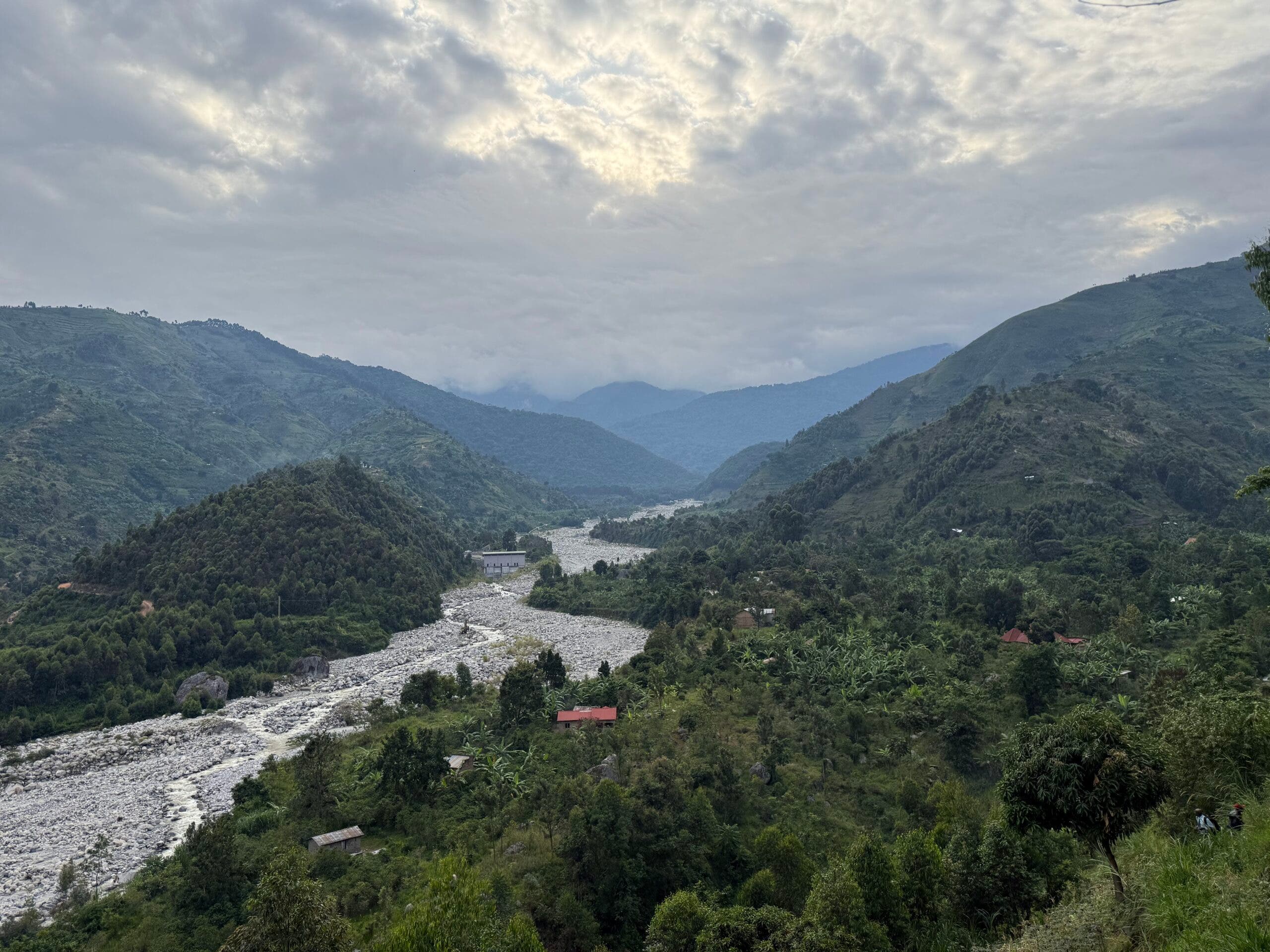
In 2020, an unstoppable wave of copper-brown flood water tore boulders the size of cars through the village, killing many and destroying thousands of homes. Driving up from Kasese, I saw the rusting carcasses of the once-vibrant homes deteriorating amid grazing goats and boulders. Every fall, when thunder crackles above the towering Rwenzoris, the village holds its breath.
“There is nothing we have not managed to do here,” says Kilabama, long-time friend of Kule and manager of Rwenzori Trekking Services (RTS). He flattens a crease in his striped polo, his feet sinking into well-worn Havaianas. Around five years ago, Kule, Kilabama, and Australian-born John Hunwick of RTS founded a tree nursery to grow indigenous trees and reforest the riparian zones between Kilembe and the river. If the trees survive, they have the potential to stop the flood in its tracks, offering a green shield against the boulders.
Kule’s role as mountain guide enabled him to promote a type of adventure tourism that catalyzed the growth of his tree nursery and attracted international researchers. “We started talking with skiers, and that’s where it all clicked. We saw an opportunity.”
The Art of Giving Back
While foreign mountain tourism invigorates the local economy and offers opportunities for cultural exchange, it fails to address the imminent, existential risk of flooding in the region.
Kule, Kilabama, and Hunwick, alongside SCU, are rapidly changing that.
Through their project, I’ve come to see the phrase “earn your turns” with new eyes. We are attracting a different kind of adventurer—Ugandans from Kampala included—that come to replant trees before they brave the Rwenzori peaks, this time on skis. It’s ultimately about giving before taking—restoring Bakonzo identity as a place of intimate connection with the misty “Mountains of the Moon” and dense forests that once protected them.
In the mountains, “If you can take time and sit alone somewhere at some point and you meditate upon yourself, you feel a changed man.”
As I sit in the shade cast by the dark banana leaves shading Kilembe’s rusting tin roofs, I can’t help but wonder if I will get a chance to ski equatorial Africa’s last powder stash before it disappears forever. But now more than ever before, the future feels hopeful.